On this page
The right mobile software development company is the one whose published work, price floor and delivery style match your project, not the one with the biggest name. Arrowbin suits startups and growing businesses that want a fixed estimate and full code ownership. TechAhead and WillowTree suit large enterprises. ArcTouch and ScienceSoft suit complex or regulated builds with bigger budgets. BuildFire suits teams that want speed on a ready-made platform, and Chop Dawg and Zco suit focused prototypes and games.
Choosing is hard because every agency calls itself full-service, and published prices run from $12,000 to $500,000 or more for what sounds like the same app. You also need to know what each firm has actually built, who works on your project, and what happens after launch.
This guide profiles eight companies under the same headings so you can compare them directly, then shows how to check prices, timelines and reviews yourself. Arrowbin comes first because we build mobile apps, and we say plainly where we are not the right fit.
1. Arrowbin
Services and expertise
Arrowbin is a founder-led software studio, building since 2020, that designs, launches and supports iOS and Android apps from one codebase in React Native or Flutter. A single senior team covers strategy, design, engineering and support, so you speak directly to the people building your product. It has shipped for more than 15 brands, and as a mobile software development company it also handles the work around the app.
- Cross-platform apps with a native-quality feel, which Arrowbin estimates cut cost by 30 to 40% compared with two separate native builds
- Store submission, review compliance and release management handled end to end
- Related services: UI/UX design, SaaS and product engineering, custom software, and monthly maintenance plans from 5 to 80+ developer hours
Fit, cost and trade-offs
It suits founders and growing businesses that need a focused MVP. A polished MVP typically costs $12,000 to $40,000, with a fixed estimate once the core features are defined, and it reaches the stores in 10 to 16 weeks. The timeline adds up: scoping takes 1 to 2 weeks, design 2 to 3 and development with testing 6 to 10, so 9 to 15 weeks of work plus a day to a week of store review. You see working software every Friday, and you own the source code, your App Store and Google Play developer accounts and all app data.
Arrowbin's pitch is predictability: a fixed estimate, weekly working demos and ownership of everything you pay for.
The trade-off is track record in mobile. Arrowbin's portfolio is mostly e-commerce and corporate sites for brands in Bangladesh, and iOS and Android apps for a jewellery brand are being built now, so ask for live mobile references before you commit. If your app is a 3D game or depends on deep hardware access, a fully native specialist is the safer choice.
2. TechAhead
Services and expertise
TechAhead says it has built apps for enterprise clients since 2009, across healthcare, finance, retail and other industries. It names Fortune 500 clients and brands such as Disney, Starbucks, ESPN and American Express, and claims 250+ mobile experts on staff.
- Enterprise mobile apps in React Native, Flutter or native iOS and Android
- AI and machine learning features, plus IoT apps for wearables and connected devices
- Healthcare apps, such as remote patient monitoring and EHR connections, that it says meet HIPAA standards
Fit, cost and trade-offs
Choose it when your app handles sensitive data or must connect to existing enterprise systems. Its own guidance puts enterprise mobile apps at $50,000 to $500,000 or more: roughly $50,000 to $100,000 for simple apps, $100,000 to $250,000 with advanced integrations, and $250,000 to $500,000+ for full enterprise builds. It quotes 3 to 9 months from concept to launch.
TechAhead is built for regulated, integration-heavy enterprise apps, and priced accordingly.
On reviews, TechAhead points to Clutch recognition, including a top ranking in Clutch's Spring 2025 App Development Awards. That is its own claim, so verify it on Clutch directly. The trade-off is scale. Budgets at this level exceed what most early-stage startups can commit, so ask who would staff a smaller project.
3. WillowTree (TELUS Digital)
Services and expertise
WillowTree, now part of TELUS Digital, is a digital product consultancy that pairs strategists and designers with engineers. It serves consumer and enterprise clients, has deep experience with streaming platforms and entertainment brands, and reports 700+ projects since the iPhone launched.
- Product strategy, UX design, full-cycle mobile development, APIs and support
- AR, voice-enabled apps and connected-device systems
- Modernization of legacy enterprise systems
Fit, cost and trade-offs
It fits large brands that need strategy, design and engineering from one partner, especially in media and entertainment. Its enterprise program is its strongest suit. A founder with a narrow MVP may be paying for more process than the product needs.
WillowTree makes sense when the app is part of a large product strategy, not a first experiment.
Pricing is not published, so request a quote and compare it with the figures in the table later in this guide. Reviews deserve a check on Clutch and Google Reviews, where you can look for specific comments on deadlines and on how problems were resolved.
4. ArcTouch
Services and expertise
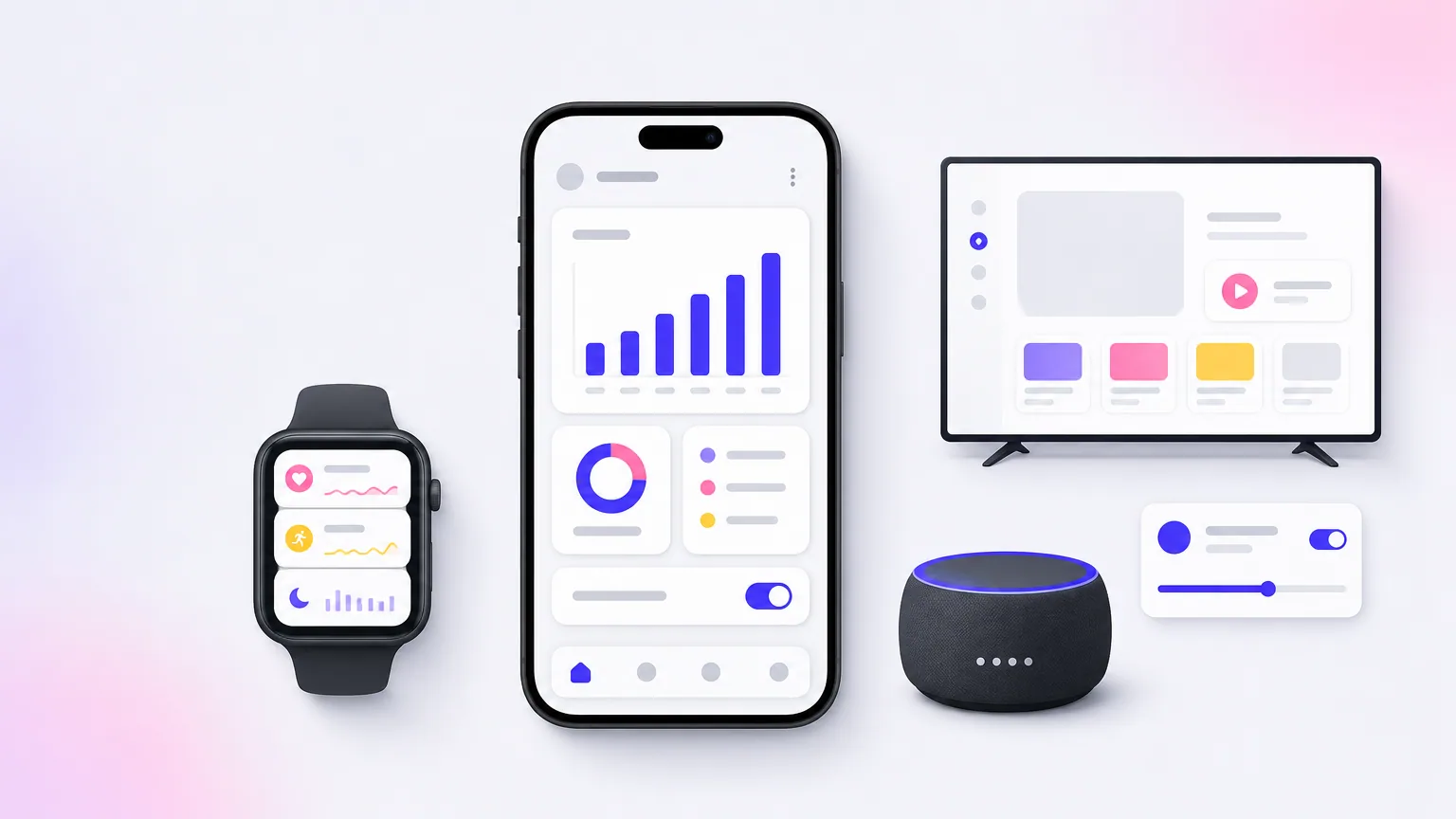
ArcTouch was founded in 2009 and builds native and cross-platform iOS and Android apps in Swift, Kotlin and other stacks. Its particular strength is connected experiences beyond the phone, and it also folds AI and machine learning into mobile products.
- Apple Watch, Android Wear and smart TV applications
- IoT and connected-device experiences
- Strategy, UX, design and support under one roof
Fit, cost and trade-offs
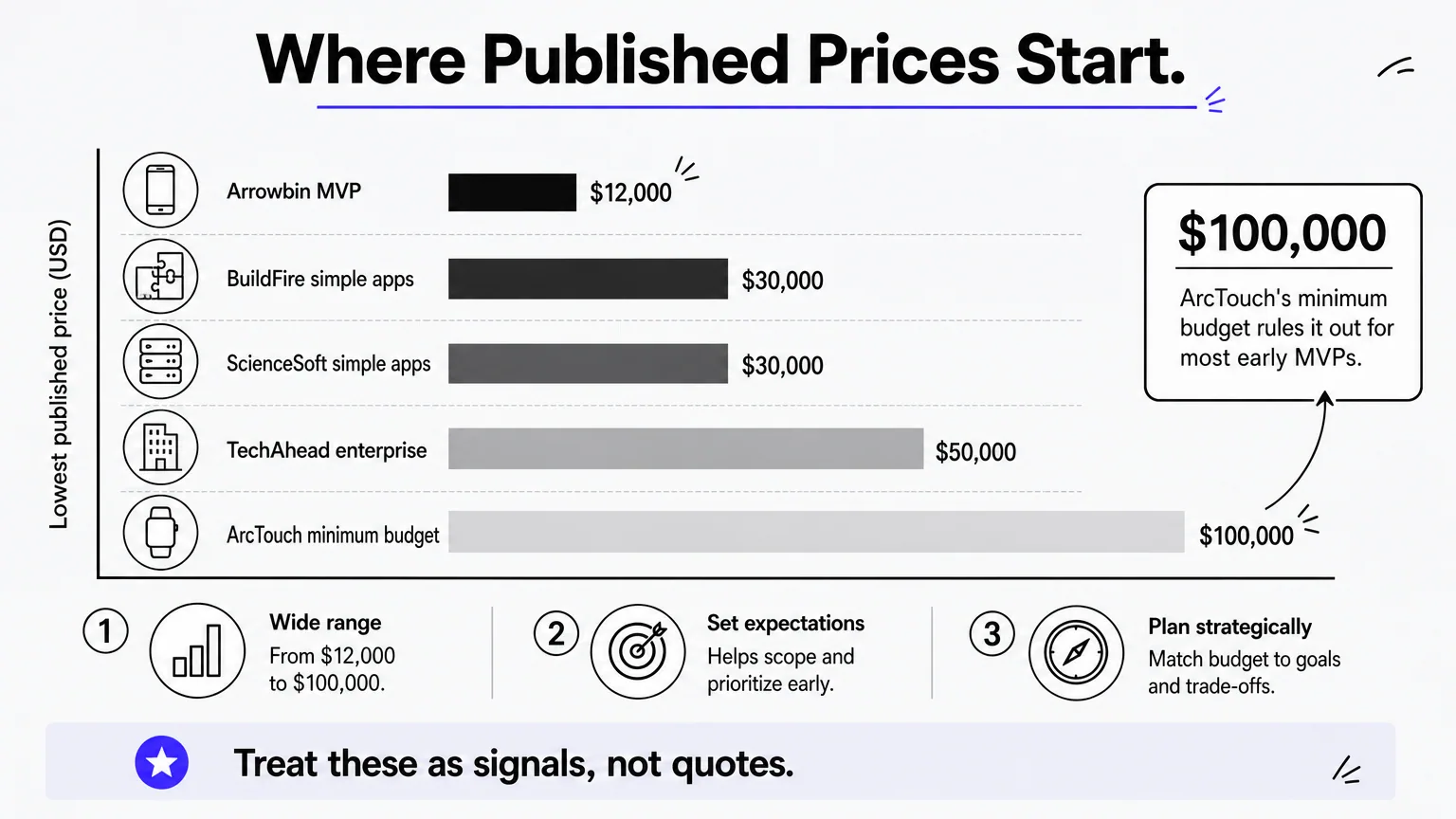
It suits funded companies building products that span phones, wearables or TVs. Its Clutch profile lists a 4.9 rating and a minimum project budget of $100,000, with enterprise and mid-sized clients. That floor alone rules it out for most early MVPs.
ArcTouch is a premium pick for connected products, and the $100,000 floor decides who can afford it.
Reviewers mention that complex projects need careful scope management. Ask for a written scope with a change-request process before work starts, and confirm who owns the code once the project ends.
5. BuildFire
Services and expertise
BuildFire takes a platform-first approach. Its backend infrastructure and core app components already exist, so developers reuse them instead of building from scratch. It says it has supported more than 10,000 apps, and it builds iOS and Android together in a single build.
- Two routes: a do-it-yourself subscription, or its agency team building the app for you
- Industries include e-commerce, education, fitness, business workflow, events and employee communication
- Fixed-price scoping, which it recommends over hourly billing
Fit, cost and trade-offs
It suits businesses that want a working app quickly and can live within a proven component set. Its published benchmarks are $30,000 to $75,000 for simple apps, $75,000 to $150,000 for mid-complexity apps and $150,000 to $250,000+ for complex ones. Timelines run 3 to 4 months for an MVP, 6 to 9 months for a full-featured app and 9 to 12+ months for complex enterprise builds.
BuildFire trades some design freedom for speed, because your app is assembled from components that already exist.
Because the app sits on a shared platform, ask three things up front: what you own, what you can customize, and how you would move away later. A custom architecture can be worth the extra cost when your product's value lies in unusual functionality.
6. ScienceSoft
Services and expertise
ScienceSoft was founded in 1989 and started mobile work in 2005, so it has the longest history on this list. It sells far more than apps: IT consulting, data analytics, cybersecurity, web development and custom software. That breadth makes it a natural application software development company for projects where mobile is one piece of a larger system.
- Complex builds such as custom CMS systems and supply chain management
- Banking and telehealth apps
- Advanced work such as embedded AR for warehouse item picking
Fit, cost and trade-offs
It fits well-funded, data-heavy or regulated projects. Ballparks taken from its own website: $30,000 to $70,000 for simple apps such as booking, $120,000 to $180,000 for complex ones such as mobile commerce, and $150,000+ for banking or telehealth apps.
ScienceSoft is a depth-and-longevity pick for complex systems, not a quick or cheap MVP route.
Mobile is one service line among many, so ask to meet the team that would actually build your app instead of relying on the company's general reputation. If your needs are simple, you will pay for capability you do not use.
7. Chop Dawg
Services and expertise
Chop Dawg has launched 400+ apps in 14 years, roughly 30 builds a year, which makes it a boutique firm. It appears among highly reviewed mobile developers in directories such as Clutch and The Manifest. Its approach lowers the risk of a first app.
- A non-functioning prototype you can use to pitch stakeholders or investors before development
- A promise to lock in the rate it quotes, so overages do not surprise you
- Smaller teams, for buyers who dislike working with large agencies
Fit, cost and trade-offs
It suits non-technical founders who want to test an idea and see it before spending serious money. The locked quote matters most when your budget is tight, because the most common mobile project failure is scope growing past the original number.
Chop Dawg is built for founders who want to see the app and know the price before committing.
Pricing is not published, so ask for a written quote. With about 30 builds a year, check its current capacity against your launch date. Also ask what the prototype costs and whether it is credited against the full build.
8. Zco
Services and expertise
Zco is based in New Hampshire, with satellite offices in Boston and New York. It specializes in virtual reality apps and mobile games, using full-stack developers across Swift, Kotlin, React Native, Flutter, MAUI, Xamarin, Java and Objective-C. One showpiece is a golf app with 3D images of 35,000 courses worldwide.
- VR and graphics-heavy mobile apps
- Games built natively or cross-platform
- Teams that can meet in person in the Northeast
Fit, cost and trade-offs
It fits games, VR and visually demanding products. Its website puts the average cost at $30,000, with builds taking up to nine months. An average hides a wide spread, so treat it as a starting point and ask for a range for your feature list.
Zco is the specialist pick: choose it for 3D, VR and games, not for a standard business app.
The trade-off is focus. If you are building a straightforward business or e-commerce app, its graphics expertise adds little, and a nine-month ceiling is slower than a platform-based route. Request examples close to your category and speak with a past client.
How to choose a mobile software development company
What the company does and why scope matters
A mobile software development company takes an idea to a live app: discovery, UX and UI design, front-end and back-end development, testing across devices, App Store and Google Play submission, and post-launch support. An application software development company is the broader term. It also builds web, desktop and internal business software, so check that mobile is a core practice and not a sideline.
The platform decision shapes the bill. Native iOS and Android builds are separate projects, while one React Native or Flutter codebase serves both. If two native builds would cost $30,000 together, a 30 to 40% saving puts a cross-platform build at $18,000 to $21,000. Apps that need heavy graphics or deep device processing can still justify native.
Published prices and timelines side by side
The table collects the figures each company publishes. Hourly rates for experienced US-based mobile developers are often quoted at $50 to $150 or more, which is why fixed estimates are easier to budget than open-ended time and materials.
| Company | Published price figure | Timeline figure |
|---|---|---|
| Arrowbin | MVP $12,000 to $40,000 | 10 to 16 weeks |
| TechAhead | $50,000 to $500,000+ by complexity | 3 to 9 months |
| ArcTouch | $100,000 minimum project budget | Not stated |
| BuildFire | $30,000 to $250,000+ by complexity | 3 to 4 months (MVP), 6 to 9 (full app) |
| ScienceSoft | $30,000 to $70,000 simple, $120,000 to $180,000 complex, $150,000+ banking or telehealth | Not stated |
| Zco | $30,000 average | Up to 9 months |
Treat these as signals, not quotes. Complexity, integrations and compliance move a price more than the company's name does, so the only comparison that counts is the same written brief sent to each one.
Questions to ask every shortlisted company
Put the same questions to each company on your shortlist, in writing, and compare how specific the answers are:
- Who will work on my project, and can I talk to them before signing?
- Can you show live apps in my category and a client I can call?
- Is the estimate fixed and itemised, and what triggers a change order?
- Who owns the source code, the store accounts and the data from day one?
- How often will I see working software, not status reports?
- What does support cost after launch, and what is the response time?
Check reviews on Clutch and Google Reviews, and read for specific details such as deadlines met and problems resolved. Ignore vague praise like "they're amazing."
Give every company the same written brief, then compare how each handles scope, ownership and support, not just price.
Where to start your shortlist
No company on this list is best for everyone. Enterprises with sensitive data lean toward TechAhead or WillowTree, connected-device and complex builds toward ArcTouch or ScienceSoft, speed toward BuildFire, and prototypes or games toward Chop Dawg or Zco. Startups and growing businesses that want a fixed price and full ownership of their code should look at Arrowbin.
Pick three companies, send each the same brief and judge them on specifics: who builds, what it costs, what you own and what support looks like after launch. If Arrowbin is one of your three, book a free 30-minute call with Arrowbin. A senior engineer will reply with scope, timeline and cost, usually within a day.