On this page
Mobile app development cost is everything you spend to design, build, launch and run an app. For most business apps, the first release lands between $10,000 and $150,000. A focused cross-platform MVP sits at the low end, a marketplace or fintech app sits in the middle to high end, and an enterprise platform can pass $400,000. After launch, plan on roughly 15% to 20% of the build price per year to keep the app working.
The spread is wide because you are not buying a product off a shelf. You are buying hours of design, engineering, testing and project management, and the number of hours depends on what the app has to do. This guide turns that into a budget you can use. It covers why the number matters, how to calculate it, what each tier of app costs, which factors move the price, what you pay after launch, and how to compare quotes.
We build iOS and Android apps at Arrowbin, a software studio that works with startups and growing businesses, so the examples below follow how real estimates get put together. Use them to set a realistic budget before you ask any studio for a quote.
Why mobile app development cost matters before you build
The cost decides what you can build, who can build it, and whether the app is still alive a year after launch. A founder who sets the budget late ends up cutting features or quality in the middle of the project, which is the most expensive moment to cut.
The number shapes scope, platform and team
A budget works backward into every decision. With $30,000, you pick one core workflow, a cross-platform build and a lean design. With $150,000, you can add payments, an admin panel and a second user role. Without a number, a quote can be anything, and you cannot tell whether it is fair.
Starting from a budget also protects your schedule. Time and cost move together, because more months means more developer, designer and QA hours. If you must launch before a season or an event, the deadline is a budget constraint, not a separate problem.
Why quotes for the same app differ so much
Two studios can quote the same app at $25,000 and $120,000 and both be honest, because they are pricing different things. Five differences explain most gaps:
- Hours assumed: how many screens, states and edge cases each studio counted.
- Hourly rate: where the team works and how senior it is.
- Platforms: one native app, two native apps, or one cross-platform codebase.
- What is included: design, backend, QA, store submission and post-launch support.
- Who carries risk: a fixed price or open-ended hourly billing.
A quote only means something once you know which hours, rate and inclusions sit behind it.
Build cost is one of three budgets
Every app has a build budget, a run budget and a growth budget. The build budget is what quotes show. The run budget covers hosting, maintenance, store fees and third-party services. The growth budget is marketing and user acquisition, and it is entirely separate from development.
Founders also ask what an app with 10,000 users is worth. User count alone does not answer that. Revenue per user, retention and growth do. What your cost gives you is the payback baseline. If year-one spending is $95,000 and the app nets $8,000 a month, you break even in about 12 months.
How to estimate your mobile app development cost
The most reliable way to estimate mobile app development cost is to multiply hours by an hourly rate, add the costs that are not labor, and then check the result against how budgets usually split across project stages.
The formula with a worked example
The formula is: development hours × blended hourly rate + non-labor costs = build budget. Blended means the average across designers, engineers, QA and project management, not the rate of your best developer.
Take a medium MVP with login, profiles, one core workflow, payments, push notifications and an admin panel. Across design, engineering, QA and project management, that is roughly 1,600 hours. At a blended $50 an hour, the build comes to $80,000. Every later figure in this guide builds on that example.
Where the money goes by stage
Published breakdowns give development 40% to 60% of the budget, design 15% to 25%, and discovery, testing and launch the rest. Here is the $80,000 example split with typical weights:
| Stage | Share | Hours | Cost |
|---|---|---|---|
| Discovery and scoping | 10% | 160 | $8,000 |
| UX and UI design | 15% | 240 | $12,000 |
| Development | 55% | 880 | $44,000 |
| Testing and QA | 15% | 240 | $12,000 |
| Launch and store submission | 5% | 80 | $4,000 |
| Total | 100% | 1,600 | $80,000 |
If a quote shows development at 85% of the price, something is missing. Usually it is design or testing, and you pay for it later as rework.
A healthy estimate spends money on discovery, design and testing, not only on coding.
Five steps to build your own estimate
- List every feature as a short user story, then label each one must-have, should-have or later.
- Pick a platform strategy: one platform first, or one cross-platform codebase for both.
- Estimate hours per feature bundle, using the feature table later in this guide or a studio's scoping session.
- Multiply by a realistic blended rate for the team model you plan to use.
- Add a contingency of 10% to 20%, then add a first-year run budget of 15% to 20% of the build price.
Online cost calculators are fine for a ballpark. They ask for a platform and a set of checkboxes, so they cannot see your integrations, compliance rules or legacy systems. Treat the output as a starting point and confirm it with a written estimate.
Mobile app development cost by app complexity
Complexity is the biggest single driver, and it sorts most apps into four tiers. Across published estimates the numbers overlap a lot, so read each range as a band, not a promise. The low end usually reflects lean teams and cross-platform builds, and the high end reflects larger agencies in high-rate markets.
Four tiers from simple to enterprise
| Tier | Typical scope | Typical timeline | Typical range |
|---|---|---|---|
| Simple | Login, profiles, a few core screens, basic content | 2 to 4 months | $10,000 to $50,000 |
| Medium | Payments, push notifications, chat, admin panel, third-party APIs | 4 to 6 months | $50,000 to $150,000 |
| Complex | Real-time features, custom backend, two-sided marketplaces, AI features | 9 to 12 months | $150,000 to $400,000 |
| Enterprise | High scale, compliance, legacy integrations, several user roles | 12 to 18+ months | $400,000+ |
A focused MVP is often built in the simple-to-medium zone. At Arrowbin, a polished cross-platform MVP usually lands between $12,000 and $40,000 and reaches the stores in 10 to 16 weeks, depending on features and integrations. That is a first version, not a finished product with every feature a mature competitor has.
Cost by app type
The category of your app changes user volume, security needs and the number of apps you must build. An on-demand service, for example, often needs a customer app, a provider app and an admin panel.
| App type | Typical range | What pushes it up |
|---|---|---|
| E-commerce | $30,000 to $250,000 | Catalog size, payments, personalization, order admin |
| On-demand services | $50,000 to $200,000 | Separate customer and provider apps, live tracking |
| Social or messaging | $50,000 to $300,000+ | Real-time chat, media, moderation, scale |
| Healthcare | $40,000 to $400,000+ | Privacy compliance, records integration |
| Fintech | $30,000 to $300,000+ | Payment security, identity checks, regulation |
The wide gaps inside each row come from scope. The low number is a stripped-down first release, and the high number is a full-featured product.
Two apps in the same category can sit $200,000 apart, so price your feature list, not your category.
The factors that drive mobile app development cost
Five factors do most of the work: features, platform, design, backend and compliance, and AI. Team model also matters a great deal, and it gets its own section next.
Features and functionality
Every feature adds design, build, test and maintenance hours, and some are far heavier than others. Login is a day or two of work with a good library. Real-time sync can take weeks. Use this table as a guide to relative weight. The full app also needs design, backend, QA and launch work on top.
| Feature bundle | Examples | Typical cost | Typical effort |
|---|---|---|---|
| Basic | Accounts, profiles, content lists, simple dashboard | $10,000 to $20,000 | 3 to 6 weeks |
| Moderate | Messaging, push notifications, payments, analytics | $20,000 to $30,000 | 6 to 10 weeks |
| Advanced | Recommendations, real-time sync, AR, role-based access | $30,000 to $50,000+ | 10 to 16 weeks |
Ship the core feature set first. Everything that is not needed for the first user to complete the main task can wait for version two.
Platform choice
iOS and Android cost about the same to build individually, so the real question is whether you build twice or once. Two native apps roughly double the work. Cross-platform tools such as React Native and Flutter share most of the code and typically save 30% to 40% compared with two native builds. If two native apps would cost $60,000, a cross-platform build lands around $36,000 to $42,000.
Go native only when the app depends on heavy graphics, advanced device features or platform-specific behavior that frameworks handle poorly. A web app or progressive web app is cheaper still, but it cannot match the store presence, notifications and device access of a real mobile app.
Design and user experience
Design typically takes 15% to 25% of the budget. A standard interface built from established components costs less than a fully custom one with bespoke animation. Custom design can help a consumer brand stand out, but a utility or internal tool rarely needs it.
Research, user flows, wireframes, a clickable prototype and final screens for every state take time. A typical UI/UX project at Arrowbin runs 4 to 8 weeks from research to dev-ready files. Accessibility work, such as meeting WCAG 2.2 AA, is cheaper when designed in from the start than patched in later.
Backend, integrations and compliance
Most apps need a server side for accounts, data, files and business logic. Integrations connect the app to payments, maps, messaging and other services. Compliance adds audits and controls for regulated data. Typical ranges look like this:
| Component | Lighter scope | Heavier scope |
|---|---|---|
| Backend | $5,000 to $20,000 for basic storage and authentication | $50,000 to $200,000+ for real-time data, analytics and high scale |
| Third-party integrations | $5,000 to $10,000 for payments and login | $10,000 to $30,000 for several APIs and live analytics |
| Security and compliance | Standard encryption and secure login in normal development | Specific audits and features, $5,000 to $100,000+ |
The backend is the part buyers most often forget, because users never see it. Ask every vendor to price it on its own line.
AI features
An AI feature can be cheap to start and expensive to run. A chatbot or image recognition feature that calls an existing model through an API often adds $20,000 to $100,000 to the build. Custom models trained on your data cost much more. The ongoing cost is the surprise. Model providers charge per use, so the bill grows with every active user. Set usage limits and alerts before launch, and budget the build and the monthly run separately.
Features, backend and compliance set the price far more than the choice of iOS or Android.
How team model and location change the price
Who builds the app changes the bill as much as what you build. Freelancers are cheapest per hour, in-house teams are most expensive to carry, and agencies sit between them with the broadest skill coverage.
Freelancer, in-house team or agency
| Model | Typical cost | Best for | Main risk |
|---|---|---|---|
| Freelancer | Often $13 to $60 per hour | Small, well-defined projects | One person rarely covers design, QA, backend and project management |
| In-house team | A US app developer averages roughly $110,000 to $120,000 a year in salary alone | A long-term product with constant work | You still need a designer, QA and a manager, plus hiring time |
| Agency or studio | Roughly $25 to $75 per hour in lower-rate regions, $100 to $300 per hour in the US | A defined build with a deadline | Quality varies, so check who actually does the work |
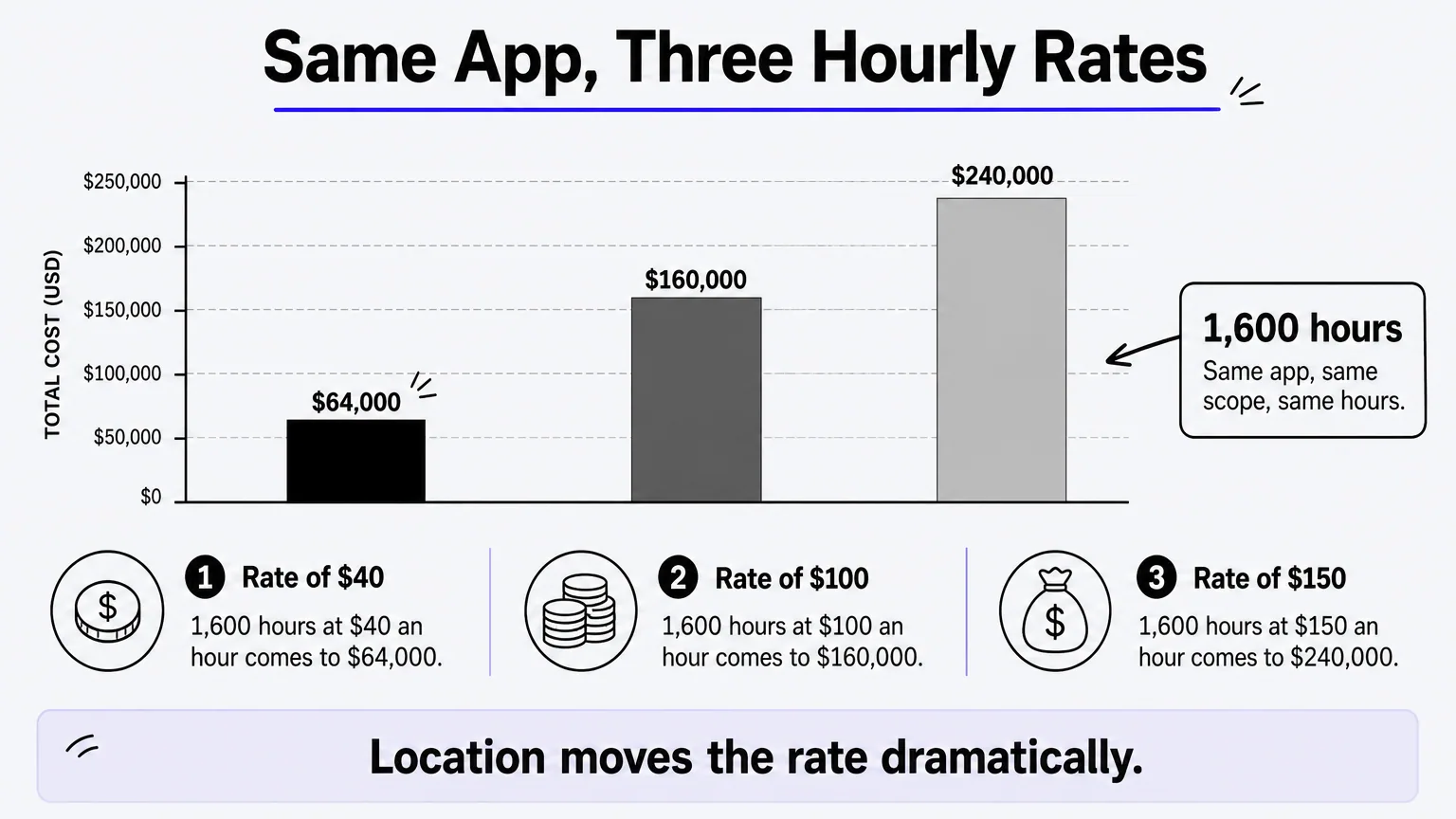
Location moves the rate dramatically. Run the same 1,600 hours at $40, $100 and $150 an hour, and you get $64,000, $160,000 and $240,000. Those figures are the same app, the same scope, and the same hours.
Why the lowest rate is not the lowest cost
A low rate helps only if the hours stay the same, and they often do not. Time-zone gaps, unclear communication and junior teams create rework, and rework is billed hours. A senior team that scopes carefully and builds the right thing the first time can beat a cheaper team on total cost.
Look at how the vendor handles risk. A fixed, itemised estimate puts the risk of overruns on the studio. Hourly billing leaves it with you. Arrowbin works with fixed estimates, a weekly Friday demo of working software, and agreed overlap hours with each client, so you see progress before the next invoice, not after it.
Compare total cost and risk, not hourly rate, because a cheap hour spent twice costs more than an expensive hour spent once.
Costs that appear after your mobile app launches
The first release is not the end of spending. Plan on 15% to 20% of the build price per year for maintenance, plus hosting, store fees and third-party services. Marketing is a separate budget.
Maintenance and support
Apple and Google release new operating system versions every year, and new devices keep arriving. Your app needs updates to keep working. Maintenance also covers bug fixes, security patches, dependency updates and monitoring. On an $80,000 build, 15% to 20% is $12,000 to $16,000 a year.
Maintenance is usually sold as a block of developer hours. Arrowbin's monthly plans come in three sizes, with 5, 20 or 80+ developer hours a month and faster critical-response times as you move up. Each plan includes monitoring, security and dependency updates, backups, bug fixes and a monthly health report. The price is agreed after a free audit of your app.
Hosting, store fees and third-party services
Store fees are small. Apple's Developer Program costs $99 a year, and a Google Play developer account is a one-time $25 fee. Hosting and infrastructure scale with your users. A small app might start at a few hundred dollars a month, and a busy one can reach $5,000 or more. Add paid APIs, SMS, email, maps and AI usage on top.
Marketing is the largest variable. Many apps budget a large share of the build cost for acquisition each year, and the right figure depends on your category and your competition. Decide it separately from development.
A year-one total for the worked example
Here is the $80,000 build carried through its first year of running:
| Item | Low | High |
|---|---|---|
| Build | $80,000 | $80,000 |
| Maintenance (15% to 20%) | $12,000 | $16,000 |
| Hosting at $200 a month | $2,400 | $2,400 |
| Store fees | $124 | $124 |
| Total, excluding marketing | $94,524 | $98,524 |
So an app that "costs $80,000" costs close to $95,000 to $99,000 in its first year, before you spend on marketing.
Budget for year one, not for launch day, because the build is only about 80% of what you will spend.
How to reduce mobile app development cost
You reduce mobile app development cost by cutting scope, not quality. The levers that work are a smaller first release, one cross-platform codebase, bought components instead of custom ones, and a fixed scope.
Start with an MVP
An MVP is the smallest version that lets a real user complete the main task. Write down that task, then test every feature against it. If the first user can finish without it, move it to version two. This is also how you learn what users want before you pay to build it.
A typical MVP timeline looks like this: 1 to 2 weeks to define scope, 2 to 3 weeks of design, and 6 to 10 weeks of development and testing, with store review adding anywhere from a day to a week. Spending 10 to 16 weeks on a focused first release costs far less than 9 months on a full product nobody has validated.
Choose cross-platform and buy common parts
React Native or Flutter saves 30% to 40% over two native apps, as covered above. Next, buy the parts that are not your edge. Use Stripe for payments, an established service for authentication, and managed cloud services instead of self-built infrastructure. Reusing generic modules such as login, settings and navigation also saves hours.
Build custom only what makes your app different. A custom payment system gives you nothing a customer will notice, and it adds security risk.
Where not to save
Some cuts cost more than they save. Do not skip these three:
- Discovery: scoping workshops prevent the rework that comes from building the wrong thing.
- Testing: QA typically takes 15% to 25% of a budget. Skipping it moves the cost to post-launch fixes and bad reviews.
- Ownership: make sure you own the source code, the developer accounts and the app data, so you can change vendors later.
The cheapest app to build is the one with fewer features, not the one with less testing.
How to compare quotes and get a reliable estimate
To compare quotes fairly, give every vendor the same feature list and compare what each price includes. The headline number tells you very little on its own.
A checklist for comparing quotes
Ask each studio to answer the same questions in writing:
- Which platforms and frameworks does the price cover?
- Which design deliverables are included: flows, wireframes, prototype, design system?
- Is QA included, and on how many devices and OS versions?
- Is the backend priced, and what hosting does it assume?
- Who handles store submission and release management?
- Is the price fixed, or time and materials with a cap?
- What does support cost after launch?
- Who owns the code, the store accounts and the data?
A vendor that cannot answer these in writing will probably fail to deliver them later.
What a fixed estimate looks like in practice
At Arrowbin, the process starts with a free 30-minute call, then a prioritised scope and a fixed, itemised estimate before any work begins. A senior engineer usually replies within a day, and a written proposal with scope, timeline, price and the team follows, with no obligation. We sign an NDA before you share anything sensitive, and you can arrive with only a rough idea, because we work out the scope together.
During the build, you get working-software demos every Friday. The source code, the App Store and Google Play developer accounts and all app data belong to you from day one.
A good estimate is itemised, fixed where possible, and clear about who owns what when the project ends.
Set your budget, then get a fixed estimate
Mobile app development cost comes down to hours, rates and scope. Simple apps start around $10,000 to $50,000, medium apps run $50,000 to $150,000, complex apps reach $400,000, and every app needs 15% to 20% of its build price each year to stay healthy. Features, backend, compliance and team model move the number most. A smaller first release and a cross-platform build move it down.
Start by listing your must-have features, pick a platform strategy, and run the formula with a realistic rate. Then ask for itemised quotes and compare them line by line. If you want a second opinion on your numbers, book a free 30-minute call with Arrowbin and get scope, timeline and a fixed estimate from a senior engineer.