On this page
The right software development company in America depends on what you are building and how much delivery risk you can carry. Thoughtworks and EPAM suit complex products where engineering depth matters most. Simform and ScienceSoft suit mid-market builds at mid-market rates. BairesDev and HatchWorks suit teams that want nearshore engineers working in US time zones. IBM Consulting and Cognizant suit large, long-running programs. Arrowbin, listed first, suits startups and growing businesses that want a fixed estimate and full ownership of their code.
Most lists of the top US software developers are directory rankings that reward review volume, so the same names show up whatever you need to build. That does not help you choose. This article gives you ten companies, what each does best, who it suits, how it charges and where it is a poor fit. After that you get a side-by-side table, a worked cost example and a five-step method for cutting the list to three.
We build software at Arrowbin, so we list ourselves first and say plainly what that means. Arrowbin is not a US-headquartered company, and our portfolio is rooted in Bangladesh. The other nine firms are US-based. We include ourselves because many US buyers care more about fixed pricing, senior engineers and code ownership than about the address on the contract.
What to look for before you shortlist
Choose a software development company in the USA by matching the firm's type to your project first, then checking proof, then comparing price. Reverse that order and you end up with a cheap vendor that has never run a project like yours.
The type of firm decides your outcome more than the name on the proposal.
Four kinds of firms, four jobs
Every company below fits one of four models. The model matters more than the brand, because it decides who is accountable when something slips. Decide which one you need before you read any pitch.
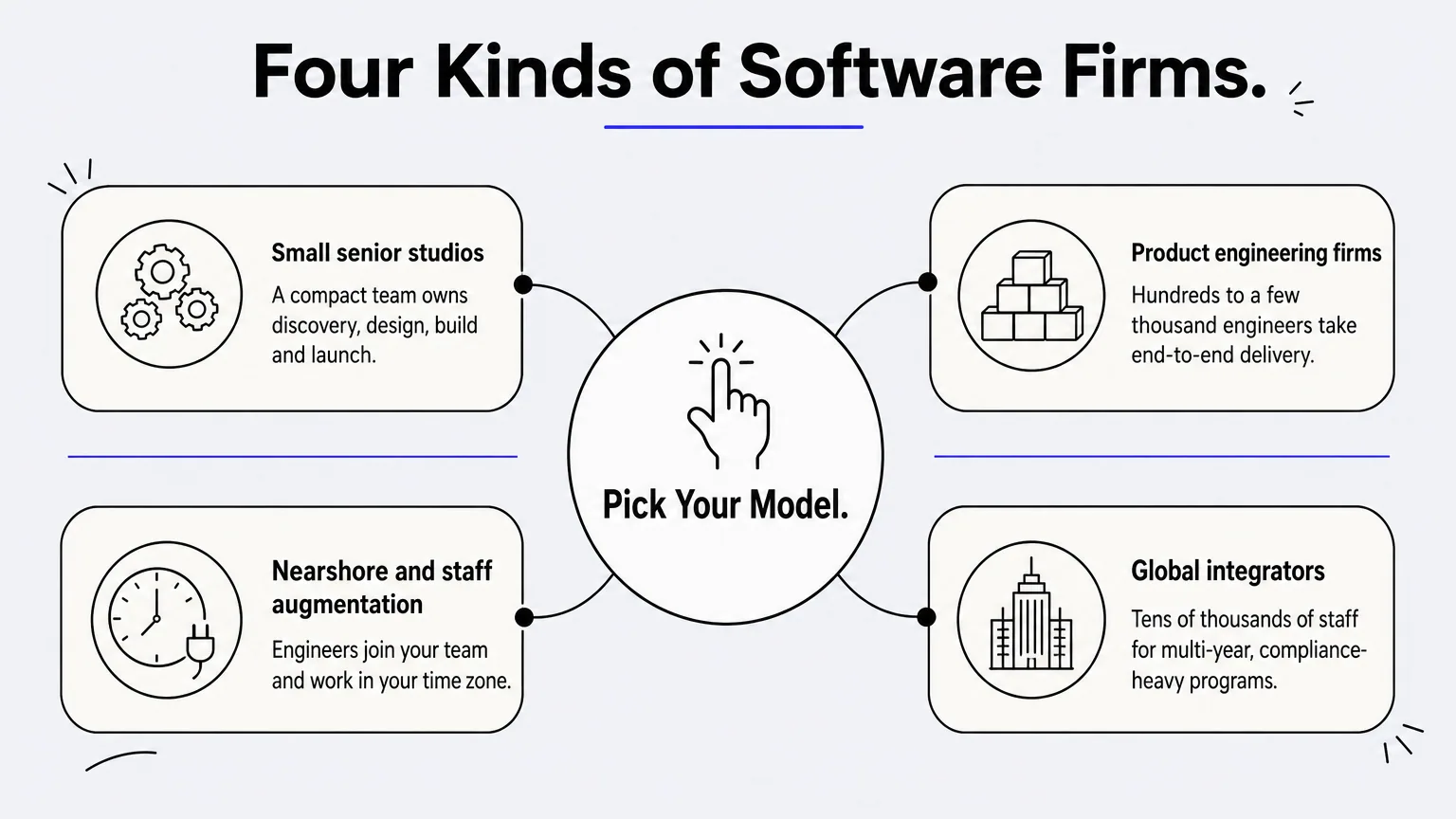
- Small senior studios: a compact team owns discovery, design, build and launch. You get fast starts and direct access to engineers, with a thinner bench.
- Product engineering and full-cycle firms: hundreds to a few thousand engineers who take end-to-end delivery. They suit teams without in-house technical leadership.
- Nearshore and staff augmentation providers: engineers join your team and work in your time zone under your direction. You need your own architect or CTO.
- Global integrators: tens of thousands of staff for multi-year programs, legacy integration and compliance-heavy work. Prices are higher.
How we picked these ten
We looked for firms with a public track record, a clear engagement model and enough depth to own delivery. We ignored paid listings and raw review counts, because directories can be bought and a high count says little about project fit. The list covers a range of budgets and project sizes on purpose, since a $20,000 MVP and a $2 million platform need different partners.
- Engineering depth: a stated method, not just a technology list.
- Engagement flexibility: project, team extension or managed product.
- Pricing signals: a published rate band or a fixed-estimate policy.
- Honest limits: a clear idea of who the firm is wrong for.
Hourly rates below are indicative bands drawn from public comparisons. They vary with seniority, scope and engagement model, so treat them as a starting point and ask for a written quote.
1. Arrowbin
Arrowbin is a founder-led software studio, building since 2020, that designs, engineers, launches and maintains web platforms, mobile apps, SaaS products and AI systems for startups and growing businesses. It is the one non-US company on this list, so it fits best when a fixed price and full ownership matter more than a US address.
Arrowbin trades a large bench for senior engineers, fixed estimates and code you fully own.
What it does best
Arrowbin keeps strategy, design, engineering, AI, cloud and support in one senior team, so work is not handed between agencies. Clients talk to the engineers building their product and see working software every Friday.
- Custom software: web platforms, internal tools, integrations and legacy modernization, with a usable first version in 6 to 12 weeks.
- SaaS MVPs in 8 to 14 weeks, with Stripe billing and multi-tenancy built in.
- iOS and Android apps from one codebase using React Native or Flutter.
- AI automation, cloud and DevOps, UI/UX design and monthly maintenance plans.
Proof of delivery is concrete. Arrowbin has shipped for more than 15 brands, and the Maneel Club store it rebuilt has taken over 10,000 orders since February 2026.
Who it suits
Arrowbin suits founders, owners and operations leads at startups and growing companies who need an external team and want clear scope and a predictable budget. It also takes clients who arrive with only a rough idea and works out the scope with them. Overlap hours and a weekly update rhythm are agreed at kick-off.
It is the wrong pick if your contract requires a US-headquartered vendor, if you need hundreds of engineers on short notice, or if you run a regulated enterprise program that needs a large compliance staff. Most of the portfolio is e-commerce and corporate sites for brands in Bangladesh, so ask to open the live projects and judge the work yourself.
Cost and engagement model
Every project starts with a free 30-minute call, then a written proposal and an itemised fixed estimate. A senior engineer usually answers within a day, and the proposal carries no obligation.
- Custom software: from $8,000 for a focused tool to $75,000+ for a full platform.
- Mobile app MVP: typically $12,000 to $40,000, live in the stores in 10 to 16 weeks.
- AI automation: typically $10,000 to $15,000 including a year of running costs.
- You own 100% of the source code, designs and infrastructure, with no per-seat license fees.
2. Thoughtworks
Thoughtworks, based in Chicago, is the pick when engineering quality and long-term capability matter more than speed or price. Its roughly 10,500 people are known for disciplined practices and for building software that ages well.
Thoughtworks sells engineering judgment, and that pays off on systems you plan to run for years.
What it does best
Thoughtworks is built around continuous delivery, test-driven development and evolutionary architecture. Its engineers write books, speak at conferences and contribute to open source. The firm also publishes the Technology Radar twice a year, which many CTOs use as a signal of what to adopt or avoid.
- Custom software and digital product development.
- Platform engineering and AI/ML integration.
- Delivery that upskills your own team as it builds.
Who it suits
It suits companies in financial services, healthcare, retail, automotive and the public sector that have an internal engineering team and want to raise its standard. Because the work is consultative, your people learn the practices and keep the knowledge when the engagement ends.
Skip it for a quick MVP on a tight budget. The depth that makes it valuable on a multi-year platform is more than a small launch needs.
Cost and engagement model
Expect premium pricing, indicatively $100 to $250 an hour. Engagements are usually long-running and collaborative rather than fixed-scope handoffs.
- Rate band: roughly $100 to $250 an hour.
- Model: embedded product teams working alongside yours.
3. EPAM Systems
EPAM, based in Newtown, Pennsylvania, is a large engineering-first firm of roughly 55,000 people, best known for hard technical problems. Choose it when complexity, not budget, is your main constraint.
EPAM earns its fee when your system is technically hard, not when it is merely big.
What it does best
EPAM is strong at complex product development for technology companies. That includes distributed systems, high-performance platforms and data-intensive applications. Its Continuum practice adds strategy and design thinking, so you can buy research and build from one vendor.
- Custom software and cloud-native development.
- Data engineering, AI/ML and quality engineering.
- UX and product design through Continuum.
Who it suits
It suits software product companies and large enterprises in financial services, healthcare, media, retail and automotive that need to scale a team with strong engineers. A large bench lets you staff quickly once the roadmap is clear.
It is overkill for a simple business app, and a small team may not get senior attention on a small account. Ask who will actually staff your project before you sign.
Cost and engagement model
Rates are indicatively $50 to $150 an hour, a wide band that reflects mixed delivery locations and seniority.
- Rate band: roughly $50 to $150 an hour.
- Model: dedicated teams or full project delivery.
4. Simform
Simform, based in Scottsdale, Arizona, is a product engineering firm of about 1,000 people with a broad stack for its size. It is a strong mid-market choice for SaaS and digital health companies.
Simform gives product teams a wide engineering stack at prices well below the big consultancies.
What it does best
Simform works on a co-engineering model, embedding its engineers in your product team instead of working at arm's length. Its practice spans cloud and DevOps, data engineering, AI/ML and digital experience. It holds Microsoft Solutions Partner status and has Databricks, AWS and Google Cloud partnerships.
- Digital product engineering and application modernization.
- Cloud, DevOps and data engineering.
- AI/ML engineering, supported by a suite of AI accelerators.
Who it suits
It suits product-led companies, especially SaaS and digital health, that need breadth across the modern stack without enterprise pricing. Financial services, retail and supply chain clients also appear in its work.
It is a weaker fit for a global, regulated, multi-year transformation that needs thousands of staff and deep compliance tooling. A firm of this size works best on focused product work.
Cost and engagement model
Simform sits at the low end of this list, indicatively $25 to $99 an hour.
- Rate band: roughly $25 to $99 an hour.
- Model: embedded product teams or scoped builds.
5. ScienceSoft
ScienceSoft, based in McKinney, Texas, is a roughly 750-person firm that has operated for about 35 years. Choose it when your project has many moving parts that you want under a single delivery structure.
ScienceSoft suits projects where software, data and compliance all have to ship together.
What it does best
ScienceSoft covers an unusually wide range, from custom applications to ERP, CRM, e-commerce, supply chain software and enterprise portals. It adds data analytics, AI and security engineering on top. Its healthcare and finance practices are the deepest, with dedicated work on regulatory compliance.
- Custom application development.
- ERP, CRM and e-commerce systems.
- Data analytics, AI software and cybersecurity.
Who it suits
It suits mid-size and larger companies in healthcare, financial services, retail, manufacturing and transportation that need application development, data infrastructure, integration and security from one party. That reduces vendor management and finger-pointing between suppliers.
Breadth has a cost. Ask which team handles your domain and request references from a project of similar scope before you commit.
Cost and engagement model
Indicative rates run $50 to $150 an hour, depending on seniority and scope.
- Rate band: roughly $50 to $150 an hour.
- Model: full-cycle projects with a single delivery structure.
6. BairesDev
BairesDev, headquartered in San Francisco, is a Latin America-based nearshore firm with more than 4,000 people. It is the choice for US teams that want offshore pricing with onshore collaboration hours.
BairesDev's value is time-zone overlap at a price below US-onshore firms.
What it does best
BairesDev provides bilingual engineers aligned to US time zones, which removes much of the friction of traditional offshore work. It says it accepts only about the top 1% of applicants, though you should verify the quality of the specific engineers assigned to you.
- Custom and full-stack software development.
- Web and mobile development, DevOps and QA automation.
- AI development and staff augmentation.
Who it suits
It suits US companies with internal technical leadership that want to extend capacity quickly in technology, healthcare, e-commerce, automotive or financial services. Teams without an architect or product owner should ask for full-cycle accountability in the contract.
It is not built for very small budgets. Its typical engagements are enterprise scale.
Cost and engagement model
Indicatively $50 to $99 an hour, which is where most nearshore firms sit.
- Rate band: roughly $50 to $99 an hour.
- Model: staff augmentation, dedicated teams or project delivery.
7. HatchWorks
HatchWorks, based in Atlanta, is a firm of 101 to 250 people that builds AI into the development process itself. It is a good pick when team stability across a multi-year roadmap is your main worry.
HatchWorks bets that AI-assisted delivery and low turnover beat raw team size.
What it does best
HatchWorks promotes Generative-Driven Development, which uses AI tooling across the whole software lifecycle, not just inside the product. Its nearshore teams are English-fluent and work in US time zones. The firm publishes an engineer retention rate of 98.5%, which is its own figure, so ask how it is measured.
- Custom software development and AI-augmented delivery.
- Data analytics, DevOps and technology consulting.
- Outcome-based delivery scoped around business results.
Who it suits
It suits product-led organizations in telecommunications, financial services, healthcare, logistics and enterprise SaaS that want development velocity and a stable team over several years. Outcome-based scoping also helps when you answer to a board that wants results, not billed hours.
As a smaller firm, it has less capacity than the large players. Confirm it can staff your project at the pace you need.
Cost and engagement model
Indicative rates are $50 to $99 an hour, with an outcome-based option.
- Rate band: roughly $50 to $99 an hour.
- Model: nearshore teams, staff augmentation or outcome-based scopes.
8. TELUS Digital (formerly WillowTree)
TELUS Digital, formerly known as WillowTree and based in Charlottesville, Virginia, is a product studio of about 1,000 people focused on mobile and cross-platform experiences. Choose it when design quality drives your product's success.
Pick a studio like this when the interface and user engagement are the product.
What it does best
The studio combines product strategy, UX design and engineering in one team. That produces consumer apps judged on engagement as much as on code. Its AI work focuses on intelligence inside consumer-facing products rather than back-office machine learning.
- Mobile development for iOS and Android.
- Web development and platform engineering.
- Product strategy and creative design.
Who it suits
It suits media, consumer, financial services and healthcare brands that are building a polished, customer-facing app or connected experience. If your users judge you by the app, this is the kind of team to look at.
It is a poor fit for internal back-office systems or data pipelines, where its design strengths add cost without adding value.
Cost and engagement model
Indicatively $100 to $200 an hour, reflecting a premium studio model.
- Rate band: roughly $100 to $200 an hour.
- Model: studio-led product projects.
9. IBM Consulting
IBM Consulting, based in Armonk, New York, is the strongest choice when new software has to connect to legacy systems. Its edge is integration with mainframes, older ERP platforms and hybrid cloud.
IBM's advantage is the old systems it already knows how to connect to.
What it does best
IBM combines modern engineering with decades of enterprise heritage. Its watsonx AI platform and a co-creation method it calls the garage give clients a structured way to build alongside its teams. Few pure-play software firms match its ability to integrate with mainframe and hybrid cloud environments.
- Cloud-native development and application modernization.
- Enterprise integration and DevOps.
- AI-embedded engineering on watsonx.
Who it suits
It suits large organizations in banking, insurance, government, telecommunications and healthcare where software must work with regulated data and long-lived infrastructure.
It is not a fit for startups or small budgets. The process and price assume an enterprise program, and a small MVP would be lost inside it.
Cost and engagement model
Indicatively $150 to $300 an hour, among the highest on this list.
- Rate band: roughly $150 to $300 an hour.
- Model: large, multi-workstream consulting programs.
10. Cognizant
Cognizant, based in Teaneck, New Jersey, is one of the largest pure-play technology services firms, with more than 340,000 people. It suits long-running programs where cost efficiency at scale matters as much as technical depth.
Cognizant is a volume play: broad capacity at a lower rate than premium consultancies.
What it does best
Cognizant covers full-cycle application development, platform modernization, cloud engineering, QA automation and AI integration. Its onshore and offshore hybrid model manages cost across big programs, and its clients include major banks, insurers, healthcare systems and retailers.
- Custom application development and legacy modernization.
- Cloud and platform engineering.
- QA automation and AI integration.
Who it suits
It suits large enterprises in financial services, healthcare, retail, manufacturing and logistics that can run a long program with a mixed delivery model and want predictable scale.
On smaller projects the account can feel impersonal. Insist on named leads and milestone-based accountability in the contract.
Cost and engagement model
Indicative rates are $75 to $200 an hour, below the premium consultancies for a comparable size.
- Rate band: roughly $75 to $200 an hour.
- Model: managed programs with onshore and offshore teams.
How to compare these companies and shortlist three
Compare on four things: company type, project size, price model and proof. Then call three firms, not ten. The table puts all ten side by side so you can drop the mismatches fast.
A shortlist of three firms that fit your project beats a spreadsheet of fifteen that don't.
Side-by-side comparison
| Company | Based in | Type | Indicative rate | Best for |
|---|---|---|---|---|
| Arrowbin | Serves clients worldwide, not US-headquartered | Small senior studio | Fixed estimate, from $8,000 | Startups, MVPs, fixed budgets, code ownership |
| Thoughtworks | Chicago, IL | Product engineering | $100 to $250/hr | Engineering quality, long-lived platforms |
| EPAM Systems | Newtown, PA | Product engineering | $50 to $150/hr | Technically complex products |
| Simform | Scottsdale, AZ | Product engineering | $25 to $99/hr | SaaS and digital health at mid-market rates |
| ScienceSoft | McKinney, TX | Full-cycle | $50 to $150/hr | Multi-component, regulated builds |
| BairesDev | San Francisco, CA | Nearshore, staff augmentation | $50 to $99/hr | Extending a team in US time zones |
| HatchWorks | Atlanta, GA | Nearshore, product engineering | $50 to $99/hr | AI-assisted delivery, team stability |
| TELUS Digital | Charlottesville, VA | Product studio | $100 to $200/hr | Consumer mobile and web products |
| IBM Consulting | Armonk, NY | Global integrator | $150 to $300/hr | Legacy and mainframe integration |
| Cognizant | Teaneck, NJ | Global integrator | $75 to $200/hr | Large, long-running programs |
What a project costs at each tier
Hourly rates are hard to compare with fixed prices, so convert them. Take a hypothetical project of 1,000 engineering hours, which is a mid-sized custom application with a few integrations.
| Tier | Example rate | Total for 1,000 hours |
|---|---|---|
| Nearshore and mid-market | $50 to $99/hr | $50,000 to $99,000 |
| Premium product consultancies | $100 to $250/hr | $100,000 to $250,000 |
| Global integrators | $150 to $300/hr | $150,000 to $300,000 |
The hourly figure is not the price you pay. A firm that misses a key architecture decision in week two costs far more than any rate difference. A fixed estimate, like the one Arrowbin issues after a free call, moves that overrun risk to the vendor, so ask every firm whether it will commit to one for a defined scope.
A five-step way to shortlist
Work through these in order, and stop when you have three names.
- Write your scope in one page: users, core workflow, integrations and a target launch date.
- Decide the model you need: full-cycle, team extension or integrator.
- Cut the list to firms whose "best for" matches your project size and industry.
- Ask each for two references on projects of similar scale, and call them.
- Request a technical session with the engineers who would work on your project, not just sales, and confirm who owns the code, accounts and infrastructure at the end.
If you only have time for a few calls, speak to one small studio, one nearshore or product firm, and one larger consultancy. The contrast in answers on timeline, price and accountability will tell you most of what you need.
Pick the company that fits the project
The best software development company in the USA is the one whose type, size and price model match your project, not the one at the top of a ranking. Small senior studios suit MVPs and fixed budgets. Product engineering and nearshore firms suit teams with technical leadership. Global integrators suit legacy-heavy programs. Compare rates by converting them into a total, and check ownership terms before you sign.
If you are launching a SaaS MVP, a mobile app, an online store or an AI automation and want a fixed estimate from a senior engineer, book a free 30-minute call with Arrowbin. You will get a clear scope, timeline and cost, and you will own the code from day one.