On this page
A good product designer hire comes down to four moves. Write a brief the designer can price, pick the platform that matches how much risk you can carry, vet candidates with a portfolio review and a short paid test, then agree rates, scope and file ownership in writing. Do them in that order and you hire on evidence instead of on a polished profile.
The search is harder than it looks. Marketplaces want to sell you their own talent, rates run from $20 an hour to $250, and the title "product designer" covers two different jobs. One person draws app screens in Figma. Another builds CAD models for a factory. Founders often pay a good designer for the wrong skill and find out in week three.
This guide walks through the four steps with a brief template, a platform comparison, vetting questions and a worked budget. Arrowbin is a software studio that designs and builds web and mobile products, so we know what a usable design handoff looks like and what goes wrong without one.
What a product designer does and which kind you need
A product designer owns how a product works and looks, from early user research to the files that a developer or manufacturer builds from. Decide which of two jobs you are hiring for before you search, because the candidate pools barely overlap.
The two kinds of product designer
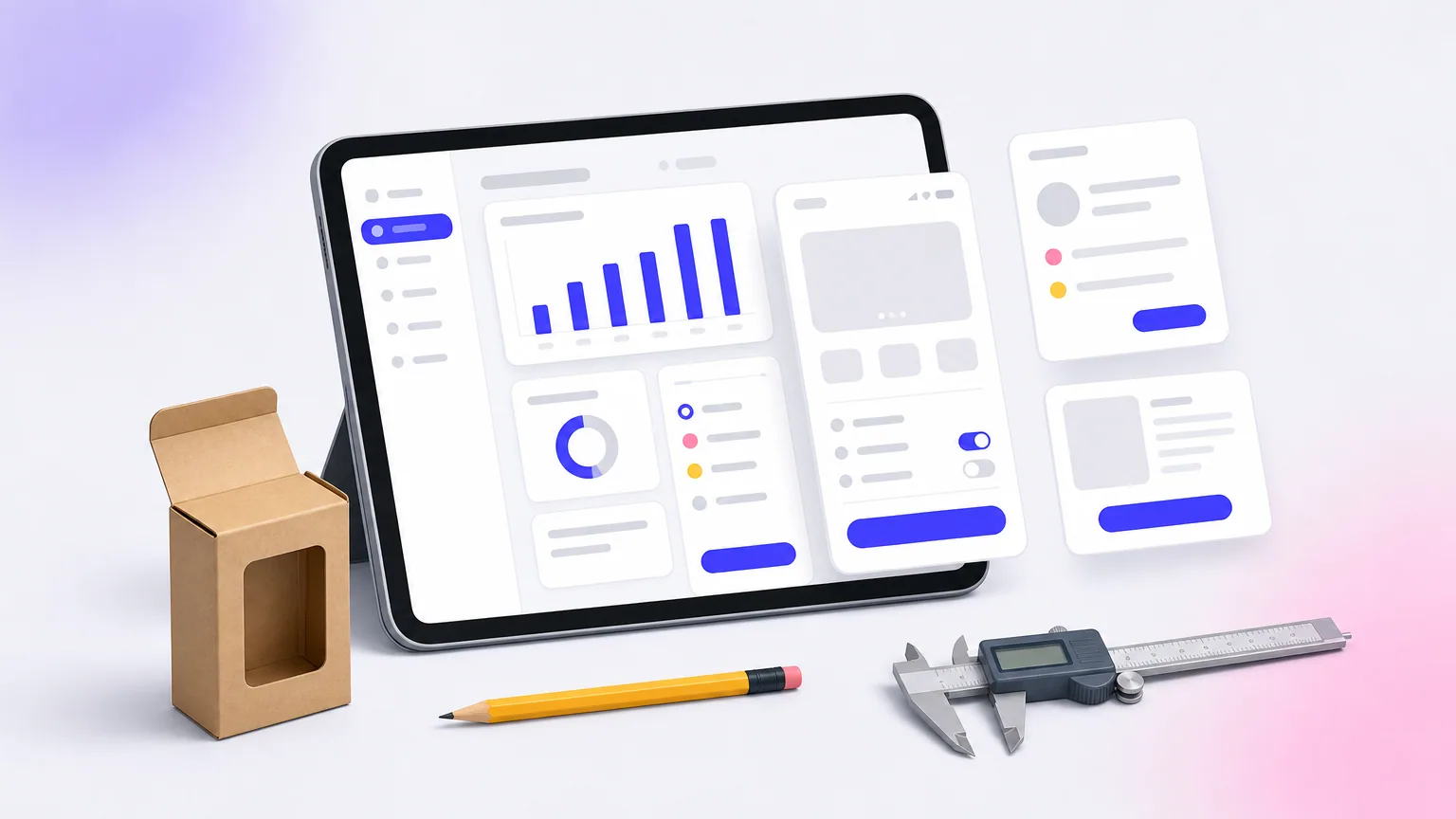
Digital product designers work on apps, websites and SaaS tools. Physical product designers shape objects such as bedding, packaging or hardware. Search for the wrong one and every profile you open will look off.
| Type | What you get | Typical tools |
|---|---|---|
| Digital (UX/UI) | Research, user flows, wireframes, clickable prototype, final screens, design system | Figma |
| Physical (industrial) | Sketches, CAD models, manufacturing-ready prototypes | CAD software |
Freelancer, employee or studio
A freelancer fits a defined project with a clear end. A full-time hire fits when design work continues every sprint. Startup product designers earn roughly $111K to $173K a year, with a median of $137K, according to Recruiting From Scratch's review of 380 job postings from 2025 and 2026. A studio fits when design and engineering have to match.
AI tools now produce quick drafts, but they do not decide which problem is worth solving. You still need a person who owns the product decisions and can defend them.
Hire for the job you actually have: digital or physical, one project or an ongoing seat.
Step 1. Write a brief the designer can price
A designer can only quote accurately when the brief states the goal, the platform, the stage and the deliverables. A vague brief attracts vague bids, and the cheapest one usually wins for the wrong reason.
What the brief must include
Cover six points: the user and the problem, the platform (web, iOS, Android or a physical object), the stage (idea, MVP or redesign), the deliverables you expect, the deadline, and a budget range. Naming the budget feels risky, but it filters out designers who work at a different level than you can afford.
For timing, a scoped digital project typically runs 4 to 8 weeks from research to developer-ready designs. That is the benchmark we use at Arrowbin, and it is a useful sanity check against any bid that promises two weeks.
A brief you can copy
Project: [one-line product description]
User and problem: [who uses it, what they struggle with today]
Platform: [web / iOS / Android / physical product]
Stage: [idea / MVP / redesign of existing product]
Deliverables: user flows, wireframes, clickable prototype,
final screens for all states, Figma file with components
Timeline: [start date] to [delivery date]
Budget: $[min] to $[max], fixed price or capped hours
Developers: [in-house / external / not hired yet]
A brief with a budget range and named deliverables gets better bids than a long one without them.
Step 2. Pick the platform that fits your risk
Choose the platform by how much vetting you want to do yourself. Curated networks cost more but screen candidates for you. Open marketplaces give you more bids and put the screening on your shoulders.
Compare the main options
| Platform | How it works | Best when |
|---|---|---|
| Toptal | Curated network, hourly, part-time or full-time contracts | You want screened talent and can pay for it |
| Upwork | Open marketplace, typical rates listed at $20 to $50 an hour | You want many bids and will vet yourself |
| Behance | Portfolio-first, designers send proposals, payments handled in the platform | Visual quality is your main filter |
| Fiverr Pro | Fixed-price projects, product design listed from $520 per project, CAD and prototype focus | You need a narrow physical-product job |
| WorkGenius | Pre-vetted designers with Figma and UX skills, matches in as little as 48 hours | Speed matters most |
How to choose between them
If you are a non-technical founder with a first project, start with a curated network or a portfolio-first platform. You pay more per hour, but you spend fewer evenings reading unqualified proposals. If you have hired designers before and know what good work looks like, an open marketplace gives you the widest choice.
Location rarely matters for a freelancer, so a search for a designer "near me" shrinks your pool for no benefit. Ask for overlapping working hours instead, and agree on a weekly update rhythm up front.
The platform decides who screens the candidates, you or them. Pay for screening only if you cannot do it yourself.
Step 3. Vet portfolios and run a paid test
Vet a designer on process and outcomes, not on how attractive the screens look. Then confirm with a small paid task before you sign a full contract.
What to look for in a portfolio
Good case studies explain the problem, the constraints, the decisions and the result. A gallery of finished screens proves taste, not judgment. Check that the designer says what they personally did on each project, because team credit is easy to blur.
Ask these five questions in the first call:
- Which project here would you redo, and why?
- How do you hand files to developers?
- How do you handle feedback you disagree with?
- What did you change after users tested your design?
- Can I speak to one past client?
Run a short paid trial
Give the top two candidates a small paid task, such as redesigning one flow from your brief. A few hours to two days is enough. Never ask for free spec work, since strong designers will decline it and you will select for desperation.
Judge the trial on three things: the questions they ask before drawing, how clearly they explain their choices, and whether the Figma file is organized enough for a developer to use. A designer who asks sharp questions on day one usually delivers cleaner work in week four.
A two-day paid trial costs a few hundred dollars and can save you from a bad five-figure contract.
Step 4. Agree on rates, scope and ownership
Expect freelance product design to cost somewhere between $20 and $250 an hour, with seniority and specialty driving most of the spread. Budget by project, not by hourly rate, because the total is what you pay.
What rates to expect
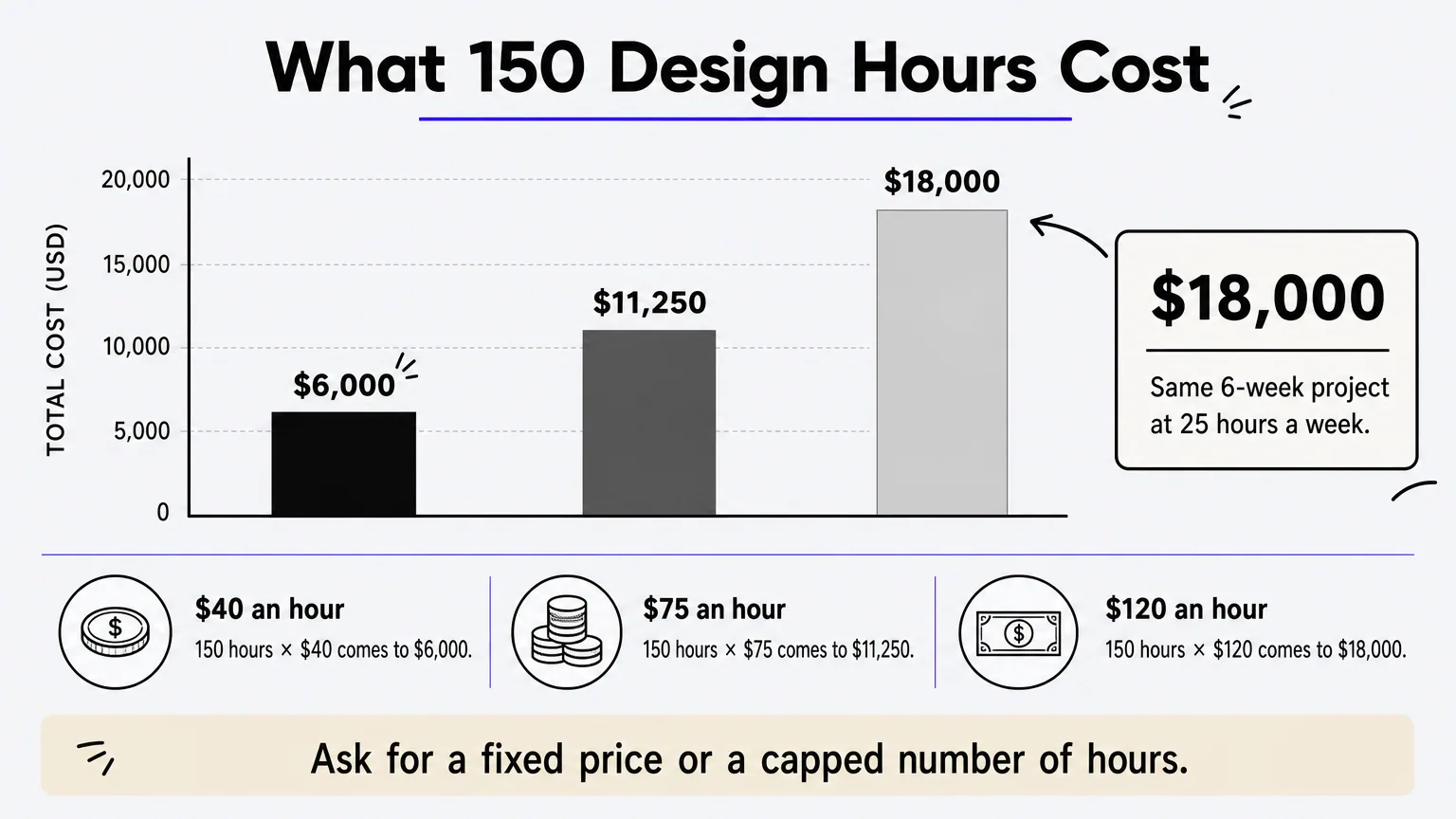
Marketplace listings cite $20 to $50 an hour as typical, while profiles on larger networks range from about $25 to $250. For comparison, a $137K startup salary works out to about $66 an hour over 2,080 working hours, before benefits and taxes. Here is a worked example for a 6-week project at 25 hours a week, which is 150 hours:
| Hourly rate | Calculation | Project total |
|---|---|---|
| $40 | 150 hours × $40 | $6,000 |
| $75 | 150 hours × $75 | $11,250 |
| $120 | 150 hours × $120 | $18,000 |
Ask for a fixed price or a capped number of hours so the middle row cannot quietly become the bottom one.
Terms to put in writing
Four terms matter most. You own all designs and source files on payment. Deliverables are listed by name, such as flows, prototype and a Figma component library. Payment follows milestones, not a single upfront sum. And an NDA is signed before you share anything sensitive. We hand over every file the same way at Arrowbin, because lock-in to one designer's private files is a cost that appears later.
The cheapest bid is not the cheapest project. A fixed scope with named deliverables is.
Start with the brief, then test
Hiring a product designer works when you decide the type of designer first, write a priced brief, choose a platform for the level of vetting you want, and confirm with a paid trial. Rates between $20 and $250 an hour only mean something once you convert them to a project total and attach written deliverables and ownership.
If you would rather get design and engineering from one senior team, you can book a free 30-minute call with Arrowbin and get a straight answer on scope, timeline and cost.