On this page
A good startup software development company does three things. It cuts your idea down to a launchable MVP, it works at your funding stage and budget, and it hands you full ownership of what it builds. Arrowbin suits founders who want strategy, design and engineering in one senior team with a fixed estimate. MTechZilla and Goji Labs suit very early teams, one leaning toward fast MVPs and the other toward design. IT Craft and SCAND suit startups that expect to grow into larger systems, and Binary Studio suits teams that want a long-term engineering unit.
Choosing is hard because nearly every agency calls itself startup friendly. Many are built around enterprise clients, and a wrong pick costs you months and often a rewrite. What you need is a way to tell a partner that questions your feature list from one that simply bills you for it.
This article gives you six options, with Arrowbin first because it is our own studio, and it says plainly where each one fits and where it does not. Every entry uses the same three headings, so you can compare them directly. A short criteria section comes first, and a side-by-side table and a cost guide with a worked example come after the list.
What a startup software development company must get right
A good partner challenges your scope, matches your funding stage and leaves you owning everything it builds. Those three tests remove most agencies from a shortlist within a few calls, and they decide the order of the list below.
Product thinking before code
Startups rarely fail because the first commit was messy. They fail because they built the wrong thing for too long. A strong partner pushes back on your feature list and asks what the smallest version that proves demand looks like.
Treat an agency that says yes to everything as a warning sign. More features mean more billable hours, so a team that keeps trimming scope is working against its own revenue and probably for you. Ask early: "Which three features would you cut from version one?"
Fit with your funding stage
What you need from a partner changes as the company matures, and a vendor that excels at one stage can be a poor fit at the next.
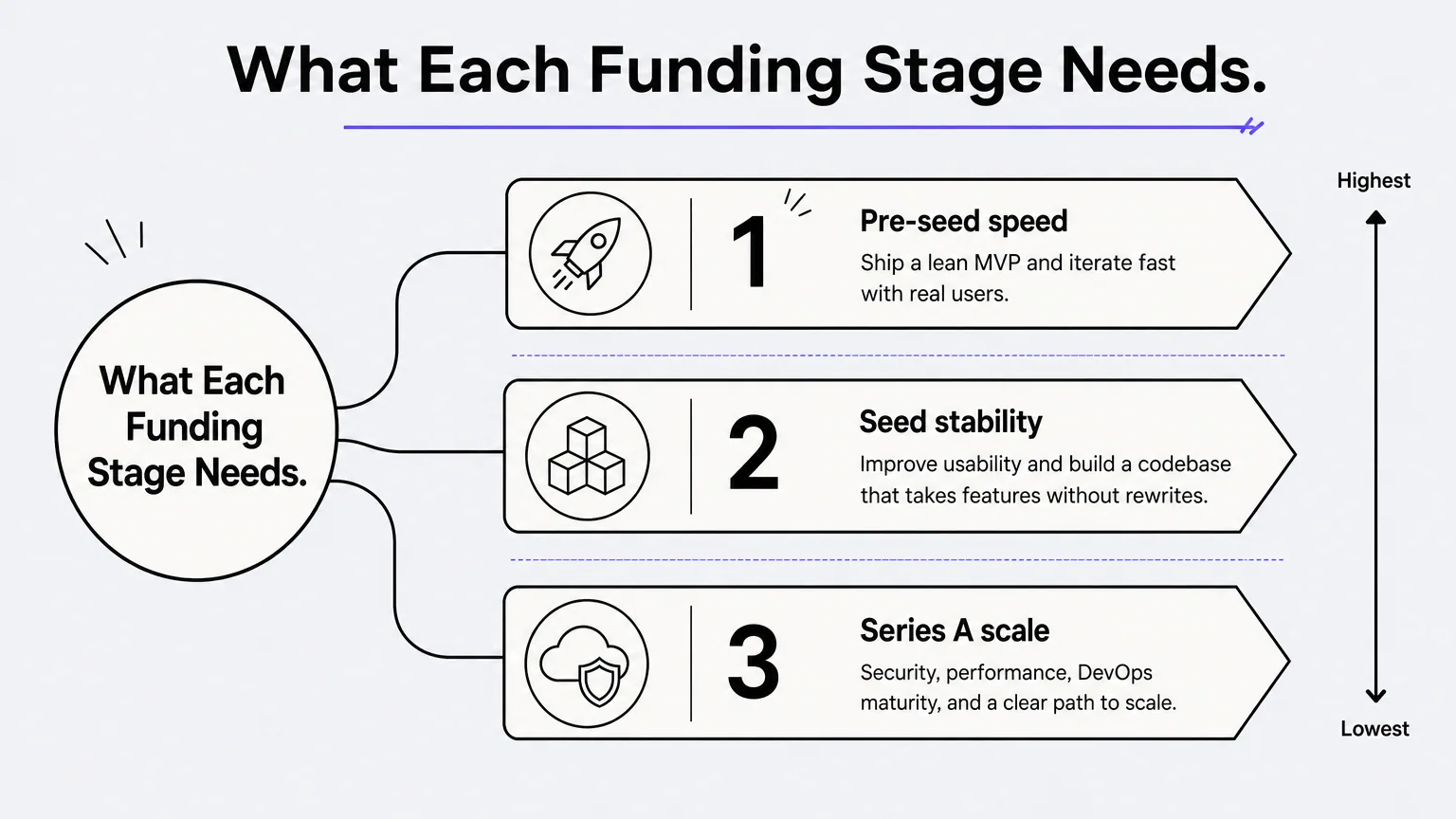
- Pre-seed: speed, a lean MVP and fast iteration with real users.
- Seed: stability, better usability and a codebase that can take new features without a rewrite.
- Series A: security, performance, cloud and DevOps maturity, and a clear path to scale.
Match the vendor to where you are now, and check that it can follow you to the next stage.
Ownership and transparency
You should own the source code, the designs, the cloud accounts and the app store accounts from day one. Without that, vendor lock-in becomes your problem the day you want to switch teams or hire in-house engineers.
Transparency matters as much. Look for itemised estimates, weekly demos of working software and direct access to the engineers doing the work, not just an account manager.
A startup partner earns its fee by shrinking your scope and handing you the keys, not by keeping you dependent.
1. Arrowbin
What it offers
Arrowbin is a software studio that designs, engineers, launches and maintains web platforms, mobile apps, SaaS products, AI systems and cloud infrastructure. Strategy, design and engineering sit in one senior team, so work is not handed between agencies. The studio is founder-led and has been building since 2020, with more than 15 brands shipped.
The services that matter most to a startup:
- SaaS and product engineering: an MVP in 8 to 14 weeks, with multi-tenancy and Stripe billing built in.
- Custom software development: a usable first version in 6 to 12 weeks.
- Mobile app development: iOS and Android from one codebase with React Native or Flutter, with an MVP in 10 to 16 weeks.
- UI/UX design: 4 to 8 weeks from research to dev-ready Figma files.
- AI automation, cloud and DevOps, maintenance: for after the first launch.
The process has four steps: Discover, Design, Build, and Launch and grow. Work runs in agile sprints with a working-software demo every Friday, and you get a prioritised scope and a fixed estimate before any build starts.
Who it suits
Arrowbin fits non-technical founders and small teams who want one accountable group from idea to launch. It also accepts clients who only have a rough idea and works out the scope with them. A senior engineer answers a brief within about a day, and a free 30-minute call comes before any written proposal.
There is one honest limit. The public portfolio has seven live projects, mostly e-commerce and corporate sites for Bangladeshi brands, such as Maneel Club, which has taken more than 10,000 orders since February 2026. If you are building a regulated fintech or a deep-tech product, ask for SaaS references and speak with the engineer who would lead your build.
Arrowbin is strongest when you want one senior team and a fixed price for an MVP, and you should confirm its SaaS references before you commit to a complex product.
Cost and what to verify
Pricing is scoped individually. Smaller builds typically start around $5,000 to $10,000, a focused custom tool starts at $8,000, and a polished mobile MVP lands between $12,000 and $40,000. You receive an itemised fixed estimate after the free consultation, and you own 100% of the source code, designs and infrastructure.
Before you sign, check three things:
- Which senior engineer will work on your project, and how much of their week it will take.
- The agreed overlap hours and update rhythm for your time zone.
- Whether an NDA is signed before you share anything sensitive.
2. MTechZilla
What it offers
MTechZilla positions itself as a practical technical co-founder for early-stage startups. It has supported founders since 2021, combining fast delivery with some product strategy. It stresses agile methods, rapid iterations and transparent progress reporting.
Its core services:
- MVP and proof-of-concept development
- Web and mobile development
- UI/UX design
- Startup product consulting
- Cloud application development
Who it suits
It suits pre-seed founders who want a hands-on partner and a startup-friendly process rather than an enterprise one. Teams that want to stay close to day-to-day decisions on direction and budget will like the reporting style it describes.
It is a younger company than several others here. That is not a flaw, but it means references matter more. Ask to speak with two founders whose MVPs reached real users.
Choose MTechZilla when speed to a first testable product matters more than a long corporate track record.
Cost and what to verify
Its pricing is described as startup-friendly, which is a claim, not a figure. Ask whether the quote is fixed, hourly or capped, and what happens when scope changes mid-sprint.
- Request a written estimate that lists each feature.
- Confirm who owns the code and cloud accounts.
- Ask how many engineers work on a typical MVP.
3. Goji Labs
What it offers
Goji Labs takes a design-and-strategy-first approach and pairs engineering with product insight. It co-creates product roadmaps with founders, balancing usability, performance and business priorities. Its focus on design thinking aims to reduce rework and speed adoption.
Its core services:
- Product strategy and roadmap workshops
- UI/UX design and prototyping
- Web and mobile application development
- Feature prioritization and usability testing
Who it suits
It suits startups still unsure what the product should be, especially consumer-facing apps where first impressions drive retention. If your main risk is that users will not understand or enjoy the product, spending on design and testing early is a sound bet.
It is a weaker fit if you already have finished designs and only need engineers. In that case a build-focused partner will cost less and move faster.
Pick a design-led studio when your biggest risk is the user experience, not the engineering.
Cost and what to verify
Design-heavy engagements often start with a paid discovery or workshop phase. Ask whether that phase is priced separately and whether the resulting designs and roadmap are yours to take to another team.
- Check what the roadmap workshop delivers in writing.
- Ask how design changes are handled once development starts.
- Confirm who writes the production code.
4. IT Craft
What it offers
IT Craft says it has more than 20 years in the industry and over 2,250 projects delivered. Its work ranges from startup MVPs and proofs of concept to full enterprise systems, so it can follow a startup as requirements grow. It lists US and EU as its main regions.
Its core services:
- Custom software and website development
- Native, hybrid and cross-platform mobile apps
- MVP, discovery and product consulting
- DevOps and cloud infrastructure
- AI development and integrations
- Dedicated teams and staff augmentation
- Quality assurance and automated testing
Who it suits
It suits startups that value a long track record and a strong QA culture. It also fits founders who inherited a struggling product, because it describes rescuing and refactoring underperforming software as part of its work.
With a portfolio that size, the risk is that your project lands with a junior team. Ask who will actually write your code, and request their profiles before signing.
IT Craft is a safe, broad choice for startups that expect to grow into enterprise-grade requirements.
Cost and what to verify
Expect a quote built around the engagement model you choose, such as a fixed-scope MVP or a dedicated team. Compare both quotes for the same scope, since the cheaper model on paper is not always cheaper in total.
- Ask for a named delivery lead.
- Confirm the testing approach for your MVP.
- Check the handover terms if you move in-house later.
5. SCAND
What it offers
SCAND describes itself as a full-service company that supports startups from the first idea through scaling and long-term maintenance. It reports over 25 years of experience and 900+ delivered projects. Its depth is in the .NET ecosystem, with industry experience in fintech, healthcare, gaming and betting, logistics and e-commerce.
Its core services:
- Full-cycle custom software development
- Web and mobile app development
- Enterprise systems such as ERP, CRM and BI
- AI software and blockchain development
- Integrations, APIs and DevOps
- UI/UX design and product consulting
Who it suits
It suits startups in the industries above, teams that prefer .NET, and founders whose AI-built prototype needs hardening for production. SCAND says it helped one founder turn an AI-built MVP into a multi-tenant platform in about six months instead of an estimated eighteen.
Treat that as a vendor's own account. Ask for the details: team size, what was rebuilt and what was kept.
SCAND fits startups that want a large, established team with deep .NET and industry experience.
Cost and what to verify
Cost depends on scope and team size, so ask for estimates for two scenarios: a lean MVP and a fuller first release. The gap between them shows how well the team prioritises.
- Confirm code ownership and repository access from the first sprint.
- Ask how security and compliance work is handled.
- Check how a small startup is prioritised next to larger clients.
6. Binary Studio
What it offers
Binary Studio builds dedicated engineering teams that integrate with a startup's leadership. Instead of delivering one isolated project, it assembles a long-term unit that grows with the product. Its main market is Europe.
Its core services:
- Dedicated development teams
- Custom software development
- Web and mobile applications
- Product scaling support
Who it suits
It suits startups past the first MVP, with a multi-release roadmap and a need for steady engineering capacity. It makes sense when you want the output of an in-house team without recruiting one.
It is a poor fit for a founder who needs a quick, one-off prototype. A dedicated team pays off over many months of work, not a six-week sprint.
Hire a dedicated-team provider when your roadmap runs longer than a year, not when you need a prototype.
Cost and what to verify
Dedicated teams are usually billed monthly, so your cost scales with team size and duration. Ask how quickly the team can scale down if funding tightens.
- Confirm notice periods and minimum commitments.
- Ask about knowledge transfer if you later build an in-house team.
- Check how team members are retained over time.
How the six compare side by side
The table summarises the focus, stage and engagement style of each company. Use it to cut the list to two before you take any calls.
Comparison table
| Company | Core strength | Best startup stage | Engagement style |
|---|---|---|---|
| Arrowbin | Strategy, design, engineering and cloud in one senior team | Idea to MVP and scale | Fixed itemised estimate, monthly support plans |
| MTechZilla | MVPs, proofs of concept, cloud apps | Early stage | Agile, hands-on with founders |
| Goji Labs | UX and product strategy | Early stage, consumer products | Roadmap workshops, then build |
| IT Craft | Web, mobile, DevOps, AI, QA | MVP to growth | Project or dedicated team |
| SCAND | Full-cycle work, .NET, AI, enterprise systems | MVP to scaling | Full-cycle projects and dedicated resources |
| Binary Studio | Long-term dedicated teams | Scaling | Dedicated team |
How to narrow six to two
Start with your stage. Pre-seed teams should look at the first three rows, and post-seed teams with a long roadmap should look at the last three.
Then run the same test on both finalists:
- Send each the same one-page brief and compare the questions they ask back.
- Ask for an itemised estimate and see which one removed features.
- Request a reference from a founder at your stage.
The finalist that asks the sharper questions about your users is usually the better builder.
What a startup software development company costs
Prices vary with scope, integrations and team, so no single number fits every startup. Arrowbin's own ranges are a useful yardstick for a focused build, and any quote far outside them deserves questions.
Typical ranges and timelines
| Build | Typical price | Typical timeline |
|---|---|---|
| Custom software, focused tool to full platform | $8,000 to $75,000+ | 6 to 12 weeks to a usable first version |
| Mobile app MVP (iOS and Android) | $12,000 to $40,000 | 10 to 16 weeks |
| AI automation, first workflow | $10,000 to $15,000 including a year of running costs | 2 to 3 weeks to prototype, 3 to 6 more for production |
| SaaS MVP | Scoped individually | 8 to 14 weeks |
The main price drivers are scope, the integrations involved and how complex the business logic gets. Cutting a feature saves more than negotiating a rate.
A worked example
Say you want a focused web app plus a companion mobile MVP. At Arrowbin's figures, the web tool starts at $8,000 and the mobile MVP runs $12,000 to $40,000, so you should budget about $20,000 to $48,000 in total.

Built back to back, that is roughly 16 to 28 weeks (6 to 12 plus 10 to 16). Overlapping the work shortens it. Add post-launch costs such as hosting and maintenance from the start.
Fixed price, time and materials, or dedicated team
The contract model matters as much as the rate.
- Fixed price: best for a clearly defined MVP. You get predictability but little room for change.
- Time and materials: you pay for the hours worked. It is flexible, but the bill grows if the plan is vague.
- Dedicated team: a monthly cost for steady capacity. It suits long roadmaps, not short builds.
Avoid a fixed budget with open scope, where the agency decides which features to build. Whatever you choose, have a lawyer read the intellectual property and confidentiality clauses.
Spend your effort on a tight scope and a clear contract, because those two decisions move your total more than the hourly rate.
Choosing your build partner
The best startup partner questions your scope, fits your stage and lets you own every line of code. Use the criteria above, shortlist two companies from the table, and test both with the same brief.
If you want one senior team for strategy, design and engineering, with a fixed estimate before any work starts, book a free 30-minute call with Arrowbin. You will get a straight answer on scope, timeline and cost, with no obligation to go ahead.