On this page
The best mobile UI UX design services combine shipped iOS and Android work, usability testing before handoff, and a price that fits your stage. Arrowbin suits founders who want design and build under one fixed estimate. Ramotion suits brand-led consumer apps. Fuselab Creative suits data-heavy and government products. Designli suits non-technical founders. Netguru suits large, multi-team roadmaps. NERDZ LAB suits tight-budget MVPs. MetaLab suits well-funded companies that want a senior product partner.
The hard part is filtering. Almost every agency says it is research-led, end-to-end and obsessed with polish, and the websites look alike. Minimum projects across the firms below run from about $5,000 to $100,000, so a wrong shortlist wastes weeks of calls before you learn that a firm is out of your range.
This article lists seven options, each with the same three checks: what you get, who it suits, and what it costs. A short guide then explains how to compare them. Arrowbin is our own studio, so it comes first and you should weigh that. The other six are described from their public information.
1. Arrowbin
Arrowbin is a founder-led software studio, building since 2020, that designs mobile apps and engineers them in the same senior team. The studio treats design as one step of a four-step process (Discover, Design, Build, Launch and grow), so the people who draw your screens stay with the product through release.
What you get
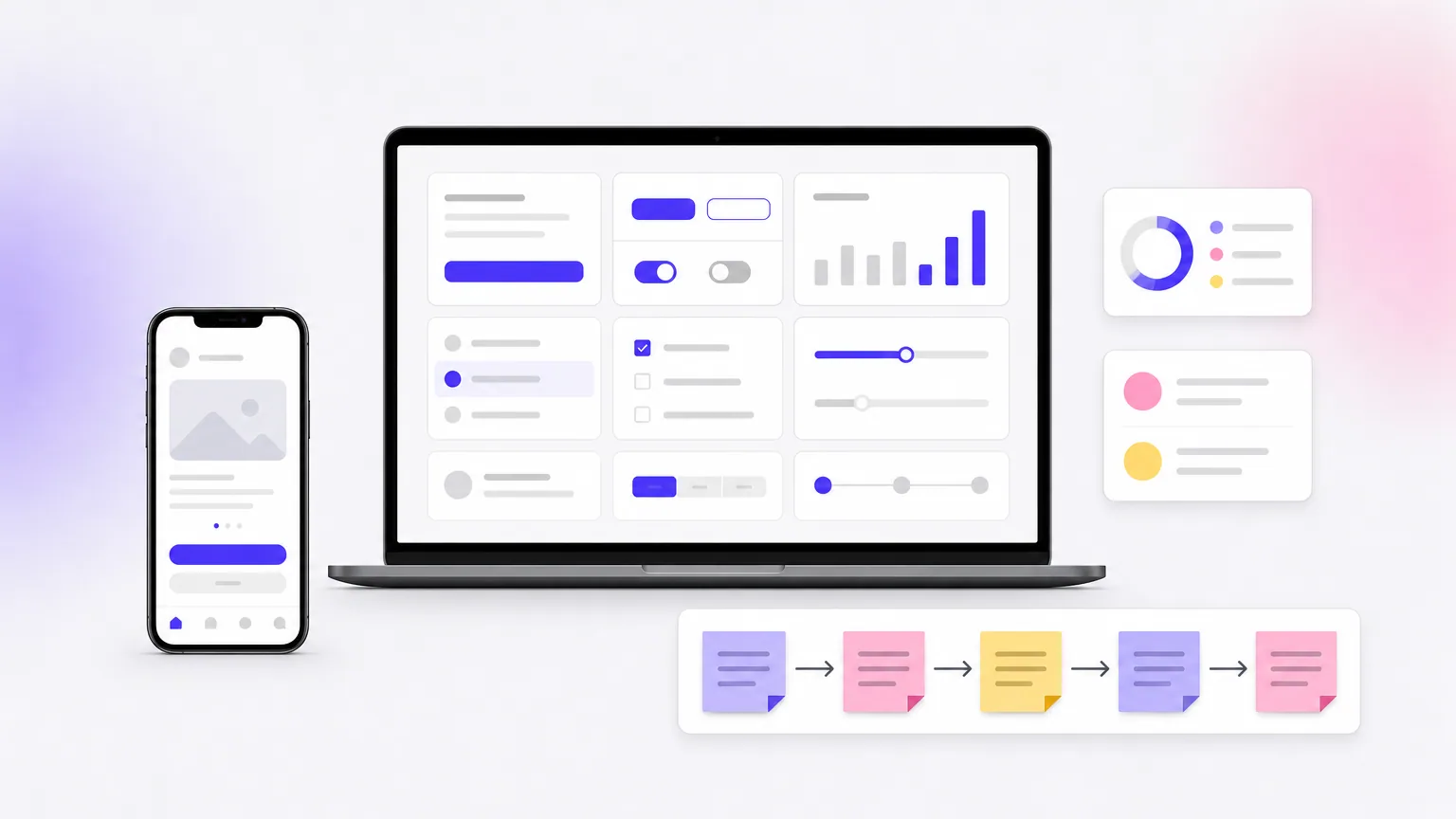
Arrowbin's UI/UX design service runs from research to dev-ready Figma files under a fixed estimate. A standalone project takes 4 to 8 weeks, and a UX audit of an existing app takes 1 to 2 weeks. Deliverables include:
- User flows and wireframes
- A clickable prototype
- Final screens for every state and breakpoint
- A design system with components and tokens in Figma
- Accessibility work to WCAG 2.2 AA
Who it suits
Arrowbin fits founders and product teams who want design and engineering from one team, without a handoff between agencies. The studio builds iOS and Android apps from a single codebase in React Native or Flutter, so one design system serves both platforms. It also accepts clients who only have a rough idea and works out scope with them.
Its listed portfolio leans toward e-commerce stores and brand sites, with Android and iOS apps for a jewellery brand in progress. Ask for mobile-specific references, and expect a direct line to a senior engineer. You own all source code, designs and store accounts, with no vendor lock-in.
Arrowbin's pitch is one senior team from first wireframe to store release, with everything you pay for handed over to you.
Cost and trade-offs
Arrowbin does not publish a design-only price. It gives a fixed, itemised estimate after a free 30-minute call. For the full build, a polished mobile MVP usually lands between $12,000 and $40,000 and reaches the stores in 10 to 16 weeks. Inside that timeline, design takes 2 to 3 weeks.
The trade-off is scope. Arrowbin is a full-service studio, not a design-only boutique. If you want a pure research and brand specialist with no build attached, one of the design-led firms below may fit better.
2. Ramotion
Ramotion is a San Francisco design studio, founded in 2009, that designs brand identity and product interfaces together. It is a strong pick when how the app looks is part of what you sell.
What you get
Ramotion keeps branding, product design, UI/UX and web development in one team. Your app, website and marketing share a single visual identity rather than being designed by three vendors. Its client list includes Netflix, Stripe, Salesforce and NBCUniversal.
Who it suits
It suits funded startups and established tech companies where brand consistency across the app and marketing carries real weight. Consumer apps that compete on feel, not on feature count, are the natural fit.
It is less suited to a first MVP on a lean budget. Its minimum project sits well above what most early-stage founders can commit to design alone.
Cost and trade-offs
Clutch lists Ramotion at $150 to $199 per hour with a $50,000 minimum and a 4.9 rating. That puts it in the top price tier. You pay for a senior, brand-led process.
Ramotion is a premium choice for apps where identity matters as much as usability, and it prices accordingly.
3. Fuselab Creative
Fuselab Creative is a design studio in McLean, Virginia, founded in 2017, that focuses on products where complexity sits behind the screen. Think dashboards, several user roles and compliance rules.
What you get
Research, UX, UI and engineering sit in one in-house team. Fuselab has worked with NASA, Fiserv, Uber and NIH, and it holds a GSA Schedule contract for federal buyers. Founders can also start from fixed-price MVP tiers instead of open-ended hourly scopes.
Who it suits
Enterprise teams, health and fintech products, and government agencies get the most from it. If your app needs permission models, data states and accessibility documentation, its track record is relevant.
A simple consumer app with a handful of screens would pay for experience it does not need.
Cost and trade-offs
Clutch lists $100 to $149 per hour, a $25,000 minimum and a 5.0 rating. That is mid-to-upper range for the US. The firm offers fixed MVP tiers as an alternative to hourly work. Check what counts as a change request before you sign any fixed scope.
Choose Fuselab when your interface has to carry complicated data and rules, not when you need a quick, light prototype.
4. Designli
Designli is a Greenville, South Carolina studio, founded in 2013, built around founders who need guidance as much as delivery. Its pitch is a structured path from idea to validated first release.
What you get
Strategy, UI/UX design and development run as one step-by-step process meant to surface risk early, before much code exists. Each client gets a dedicated team of designers, engineers and a product owner who stay from concept to launch.
Who it suits
It suits non-technical founders who do not yet know what to build first. The product owner role helps you cut scope to a releasable MVP. Designli also lets buyers speak with past founders who started from a similar idea stage, which is a useful reference check.
Teams with an in-house mobile squad that only want design files will find the bundled process more than they need.
Cost and trade-offs
Clutch lists $50 to $99 per hour, a $10,000 minimum and a 5.0 rating. That is one of the more accessible entry points among US firms. The trade-off is that you buy into its process, so ask how much of it is flexible.
Designli trades flexibility for structure, which is exactly what a first-time founder usually needs.
5. Netguru
Netguru is a Poznań, Poland product agency, founded in 2008, and one of Europe's larger ones, with 250 to 999 employees on Clutch. Size is its main reason to be on a shortlist.
What you get
Designers, researchers and engineers work together, mostly on digital commerce, marketplaces and B2B platforms. Netguru can staff several cross-functional teams at once and keep the same people across design and engineering.
Who it suits
It suits companies with a multi-year roadmap and more than one product stream. If you need capacity to scale up or down without rebuilding the team, a bigger agency is safer than a small studio.
It is a poor fit for a lean first release. A large agency brings process overhead that a two-person founding team rarely needs.
Cost and trade-offs
Clutch lists $50 to $99 per hour, a $50,000 minimum and a 4.8 rating. The hourly rate looks mid-range, but the minimum project is high. Compare the minimum, not just the rate, when you build your shortlist.
Netguru's value is capacity, so pay for it only when your roadmap really needs several teams.
6. NERDZ LAB
NERDZ LAB is a full-cycle product studio in Lviv, Ukraine, founded in 2017. It reports more than 80 clients in 15 countries and has one of the lowest entry prices on this list.
What you get
Services cover UI/UX design, iOS and Android development, web platforms and AI integration. The model is built for MVP validation and fast iteration, so you can test a mobile idea with real users before committing a bigger budget.
Who it suits
Startups that need an affordable first release and quick cycles fit best. If you want to learn whether users care before you invest heavily in design polish, this is the cheapest serious route here.
Plan for limited overlap between Eastern European and US working hours, and agree on a weekly update rhythm early.
Cost and trade-offs
Clutch lists $25 to $49 per hour, a $5,000 minimum and a 5.0 rating. The low price reflects both the region and the MVP focus. If your product needs deep research or regulated-industry compliance, budget for more than the minimum.
NERDZ LAB is the budget route to a first mobile release, best used to test an idea rather than perfect it.
7. MetaLab
MetaLab is a Vancouver-based product design firm, founded in 2006, with a distributed team across several continents. It counts Slack and Google among its clients.
What you get
The firm covers product strategy, UX research, design and engineering. It positions itself as a senior partner that sets product vision and carries it to a shipped product, not as a screen-production shop.
Who it suits
Well-funded companies that want a long-term product partner suit MetaLab. If your team has a clear mandate and a serious budget, you get an experienced outside voice at the strategy level.
Early-stage founders should look elsewhere. The price makes it unrealistic for most MVPs.
Cost and trade-offs
MetaLab publishes no hourly rate, and its $100,000 minimum is the highest in this list. It also has no Clutch reviews yet, so reference calls matter more here than with the other firms. Ask for two or three past clients to speak with you directly.
MetaLab is a big-budget, strategy-level partner, and you should verify it through references, not reviews.
How to choose mobile app UI/UX design services
Pick the firm whose shipped work looks most like your product and whose minimum fits your budget, then confirm both on a call. Three things decide the match: what the service includes, what it costs against your budget, and whether the agency can prove it designs for each platform.
What mobile UI/UX design includes
Mobile UI/UX design covers how an app is structured and how it looks. UX is the research, user flows and wireframes that decide how people move through the app. UI is the visual layer: type, color, components and states. Good services add usability testing with real users and a handoff that developers can build from.
Mobile adds its own constraints, such as thumb reach, small screens, permission prompts and weak connections. A firm that only shows desktop work has not faced them.
What the agencies cost side by side
Hourly rates among the firms above run from $25 to $199, and minimum projects from $5,000 to $100,000. Figures for the other six come from public Clutch listings and move over time, so confirm them on a call.
| Agency | Base | Hourly rate | Minimum project | Best for |
|---|---|---|---|---|
| Arrowbin | Bangladesh | Fixed estimate | Smaller builds around $5,000 to $10,000 | Design and build from one team |
| Ramotion | San Francisco | $150 to $199 | $50,000 | Brand-led apps |
| Fuselab Creative | McLean, VA | $100 to $149 | $25,000 | Complex data, government |
| Designli | Greenville, SC | $50 to $99 | $10,000 | Non-technical founders |
| Netguru | Poznań | $50 to $99 | $50,000 | Multi-team roadmaps |
| NERDZ LAB | Lviv | $25 to $49 | $5,000 | Low-budget MVPs |
| MetaLab | Vancouver | Not published | $100,000 | Well-funded product vision |
Here is a worked example. You have $20,000 for design and build. Ramotion ($50,000), Netguru ($50,000) and MetaLab ($100,000) are out, and Fuselab's $25,000 minimum is just above you. That leaves Arrowbin, Designli and NERDZ LAB. At Designli's rates, 200 hours costs $10,000 to $19,800, so check that your scope fits.
Compare minimum projects before hourly rates, because the minimum is what removes a firm from your shortlist.
Five checks before you sign
Ask each shortlisted firm these questions in the first call:
- Which live app in your portfolio is closest to ours? Look for App Store or Google Play links, not concept shots.
- How many rounds of usability testing did your last app get, and what changed because of them?
- Who writes the code, and what do I receive at handoff? You want prototypes, a component library and every screen state, including empty, loading and error.
- Which screen have you designed for iOS 26 Liquid Glass and for Material 3 Expressive on Android? A portfolio that shows one identical screen on both platforms has not adapted.
- Do I own the files, code and store accounts when we finish?
AI tools now speed up first drafts of layouts, but they do not replace research or testing with real users, which is where a good agency earns its fee. Treat an agency that sells AI as a substitute for user research as a red flag.
Picking your design partner
Choose by fit, not by reputation. Match the firm's shipped work to your product's complexity, match its minimum to your budget, and ask for proof that it designs natively for iOS and Android. Shortlist two or three agencies from this list, run the five checks, and compare answers.
If you want design and build under one fixed estimate, you can send a brief and book a free call with Arrowbin. A senior engineer replies with scope, timeline and cost, usually within a day.