On this page
If you are asking what is a product design, the short answer is this: product design is the practice of deciding what a product should do, how it should work, and how it should feel, so that real people can use it and the business behind it can sustain itself. It runs from the first problem statement to the shipped result. It applies to apps and software as much as to a kettle or a chair. A product designer is the person who turns user research, interaction design, and business goals into one consistent set of decisions.
This article explains why product design matters, walks through the five steps of the process, and describes what a digital product designer does day to day. It also sets the role against UX designers, UI designers, and product managers. A worked example near the end shows the pieces fitting together, and a short checklist helps if you plan to hire for it.
We write this from the studio side. Arrowbin designs and engineers web platforms, mobile apps, and SaaS products, so design decisions and build decisions sit in one senior team. That shapes the practical advice below, especially the parts about handoff and about what to ask for from a design partner.
Why product design matters for any product
Product design matters because it is the cheapest place to discover you are wrong. Changing a sketch costs an hour, changing shipped code costs a sprint, and changing a launched product costs customers. A product people love but that cannot earn money will not survive, and neither will a profitable product that frustrates its users. Product design keeps both sides in view.
Product design is the cheapest place to be wrong, so that is where you should be wrong first.
It stops you from building the wrong thing
Users rarely describe problems. They describe solutions: "add a bigger button," "give me an export option." Those requests are symptoms. A product designer traces the request back to the root problem, often by watching people use the product. The real cause is frequently something else, such as buyers who cannot find the checkout in the first place.
That habit saves money in a plain way. A team that builds the requested feature can ship on schedule and still miss its goal. A team that checks the problem first may build something smaller, or decide not to build at all, which is sometimes the best result a design process can produce.
It ties user value to business results
Good product design shows up in numbers a business already tracks. Three common ones:
- Speed to first value: how quickly a new user understands the product and completes a first useful task.
- Roadmap quality: which features get built, because research shows which problems cost users the most.
- Conversion and retention: whether visitors become customers and whether those customers stay.
Product design does not guarantee any of these. It gives you a way to reason about them before you pay for engineering, which is a far better time to change your mind.
How the product design process works
The product design process has five steps: set goals, research, design, test, and build and measure. Teams rarely move through them in a straight line. A finding from testing can send you back to research, and a technical limit found during the build can reshape a design you thought was done. Treat the five steps as a loop and keep running it until the goal is met.
Run the five steps as a loop, not a line, and let each test decide what you do next.
The five steps at a glance
| Step | Question it answers | Typical output |
|---|---|---|
| 1. Set goals | What does success look like? | Written goal and success metrics |
| 2. Research | Who is this for, and what is broken? | Interview notes, journey map, ranked problem list |
| 3. Design | What could solve it? | User flows, wireframes, clickable prototype, final screens |
| 4. Test | Does it work for real people? | Usability findings and revised designs |
| 5. Build and measure | Did it work after launch? | Shipped product, metrics, next iteration |
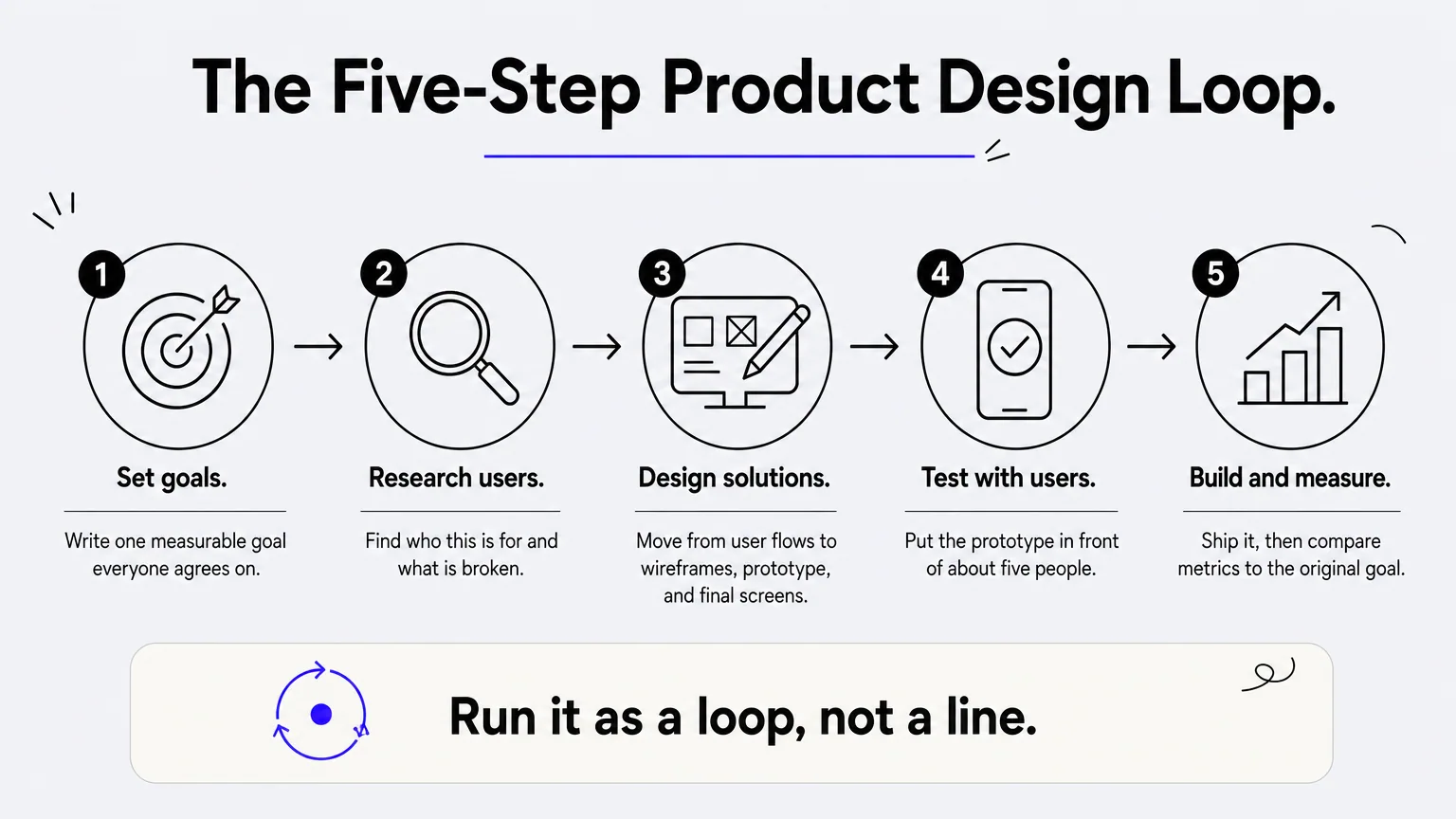
Use the table as a checklist when you scope a project. If a step has no output, it was skipped, and the risk it was meant to remove is still in the product.
Steps 1 and 2: goals and research
Start with one measurable goal. "Improve checkout" is a wish. "Raise completed checkouts from mobile visitors" can be measured. Write the goal down and get everyone to agree on it, because people hear the same words differently. "Grow retention" means fewer cancellations to one person and more engagement features to another.
Research then challenges what the team assumes. Good sources are interviews with real users, analytics, support tickets, and a review of competing products. Synthesize the findings into one shared artifact, such as a journey map or a short list of problems ranked by how often they appear. Findings that live in a slide deck nobody reopens are wasted work.
Steps 3 and 4: design and test
Design moves from rough to refined. Begin with user flows, which map the path a person takes through the product. Then draw low-fidelity wireframes that are cheap to throw away, and build a clickable prototype. Only then produce final screens, including every state: empty, loading, error, and success. Add a design system of reusable components so the product stays consistent as it grows.
Test the prototype before any code exists. Put it in front of about five people from your target audience, give them real tasks, and watch where they hesitate. A small round like this often surfaces the main usability problems. Fix them, then test again if the changes were large.
Step 5: build, launch, and measure
The designer stays involved through the build. Engineers hit edge cases the specification did not cover, and someone has to make those calls quickly. Review what ships against what was designed, and fix drift early.
After launch, compare the metrics to the goal from step 1. The gap between the two becomes the starting point of the next loop.
How long the process takes
A small feature can move through the loop in a few weeks. A new or complex product takes several months. A typical Arrowbin UI/UX design project runs 4 to 8 weeks from research to dev-ready designs, with research and wireframes each taking about 1 to 2 weeks. An audit of an existing product's UX takes 1 to 2 weeks. Plan for that range, then add buffer if you expect more than one round of testing.
What a product designer does and earns
A product designer owns the design of a product from problem definition to shipped result. That means researching users, designing solutions, testing them, and working with engineers and product managers until the product is built. The title is most often used for digital product designers who work on software, apps, and websites. It is also used for people who design physical goods.
A product designer is accountable for whether the product works for users and for the business, not only for how it looks.
Day-to-day responsibilities
Ask a product designer what they did last week and the answer rarely says "drew screens" alone. A typical week mixes several of these:
- Running or supporting user interviews and usability tests
- Mapping journeys and user flows to find where people get stuck
- Sketching wireframes and building prototypes
- Designing the final interface using a shared design system
- Presenting trade-offs to product managers and stakeholders
- Reviewing builds with engineers and handling edge cases
The hardest part is often the trade-off conversation. When a feature would please a loud group of users and complicate things for everyone else, the designer's job is to lay out the trade-off clearly and tie it to research so the team can decide with evidence.
Digital and physical product designers
A digital product designer works in tools such as Figma and designs interfaces, flows, and design systems for web and mobile products. The output is files that engineers turn into code. The work is easy to change, which makes fast iteration realistic.
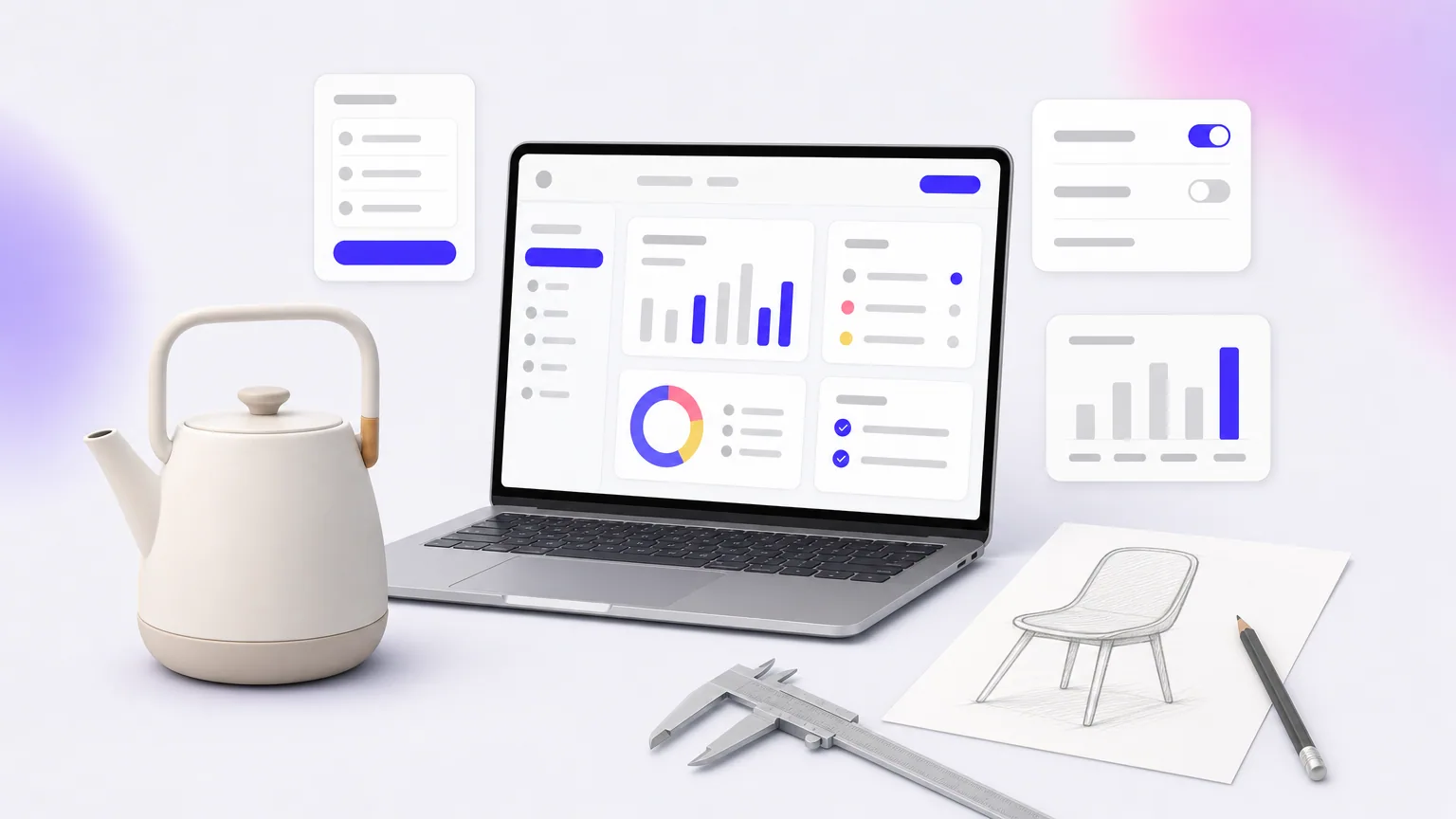
A physical product designer, often called an industrial designer, works with materials, manufacturing limits, and CAD software. Changes cost far more once tooling exists, so prototyping and testing happen earlier and more carefully. Both kinds of designer start from user needs and test their ideas, and that shared habit is why one definition of product design covers both.
Skills and pay
The core skills are interaction design, visual design, research synthesis, and clear communication of design reasoning. Tool fluency matters, but turning research into decisions matters more. Systems thinking helps too, because designers work across screens, teams, and releases.
Pay varies by seniority, company, and location. US estimates differ by source. Glassdoor-based figures put average base pay between $72,000 and $120,000, with median total pay around $119,000. Mid-level roles at larger tech companies are often quoted at $100,000 to $150,000 base. The same Glassdoor data puts UX designer median total pay near $108,000 and product manager pay near $151,000. Treat these as rough guides rather than offers.
Product designer vs UX designer vs product manager
A product designer owns the design of the whole product, including whether it fits the business. A UX designer focuses on how the experience works for users. A UI designer focuses on the visual interface. A product manager decides what to build and why. Companies use these titles loosely, and at a small startup one person often covers two or three of them.
Titles blur, so judge a role by what it owns: the whole product, the experience, the interface, or the priorities.
The differences side by side
| Role | Owns | Typical question | Main outputs |
|---|---|---|---|
| Product designer | Overall product design and its fit with business goals | Does this product work for users and for the business? | Research, flows, prototypes, final designs, roadmap input |
| UX designer | The user's experience of flows and features | Is this easy to use and understand? | Journey maps, wireframes, usability findings |
| UI designer | Visual interface and its details | Does this look right and feel trustworthy? | Typography, color, layout, component styles |
| Product manager | Priorities, roadmap, and success metrics | What should we build next, and why? | Roadmap, requirements, metrics |
Product designer vs UX designer
The overlap is large. A UX designer usually works on specific features or flows and pays less attention to broader business context. A product designer works on the same flows but also weighs cost, strategy, and long-term direction. Many companies treat the titles as interchangeable, so read the job description. If it mentions the roadmap, metrics, and business goals, it is product design in the wider sense.
Product designer vs product manager
The two roles share strategy but split the questions. The product manager owns the "what and why": which problem is worth solving this quarter and how success will be measured. The product designer owns the "how it works for people": what solving that problem looks like and whether users can actually do it.
Good teams let each role challenge the other's assumptions. A manager who hears "users cannot find this step" has better data for prioritizing, and a designer who hears "this feature is worth a lot to the business" can design around it from the start.
A worked example and what to ask for in practice
Here is the process on a small scale. The numbers below are illustrative, not real client results. They show how each step produces a decision you can act on.
Example: fixing a failing checkout
Say you run an online store that confirms cash-on-delivery orders by phone. About 120 of every 1,000 monthly orders end in a fake or refused delivery.
- Goal: cut failed deliveries from 12% to 8% of orders without lowering completed checkouts. At 1,000 orders a month, that is 120 down to 80, or 40 fewer failed deliveries.
- Research: read the order logs, call eight customers whose orders failed, and review support tickets. The pattern: people picked the wrong delivery city, or did not expect the confirmation call.
- Design: ask for city and phone number early, show the delivery charge before the total, and explain the confirmation call on the page. Wireframe two versions of the flow.
- Test: put a clickable prototype in front of five buyers and rewrite the wording where they hesitate.
- Build and measure: ship it, then track the failed-delivery rate for a month against the 12% baseline.
Notice that no step required guessing about taste. Every decision traced back to a number or an observation.
What to ask for when you hire design help
If you commission product design, whether from a freelancer or a studio, ask for outputs you can check:
- Deliverables: user flows, wireframes, a clickable prototype, final screens for every state and breakpoint, and a design system in Figma.
- Accessibility standard: a named target such as WCAG 2.2 AA, not a vague promise.
- Ownership: all design files and assets belong to you.
- Scope and timeline: a fixed estimate and a stated duration for research, wireframes, and handoff.
- Engineering contact: a designer who works with the people building the product.
Arrowbin's UI/UX design service, for example, covers research to dev-ready Figma files under a fixed estimate, and you own all of it. Use the same list to judge any provider.
Where to start with product design
Product design is the practice of deciding what a product does, how it works, and why it deserves to exist, from first problem statement to measured result. The process is a five-step loop of goals, research, design, testing, and building with measurement. A product designer owns that loop and shares it with UX designers, UI designers, and product managers, who each hold a different part of the same product.
If you are planning a new product or rebuilding one, begin with one measurable goal and a handful of conversations with real users. That alone puts you ahead of most teams. When you want senior help turning the answers into designs and working software, book a free 30-minute call with Arrowbin and get a straight answer on scope, timeline, and cost.