On this page
Cloud managed hosting, usually written as managed cloud hosting, is a service where a provider runs your servers on cloud infrastructure and also operates them for you. Provisioning, security patches, monitoring, backups and scaling become the provider's job. You deploy your website or application, and the provider keeps the environment healthy.
Think of it as the difference between renting a car and hiring a driver. Cloud hosting spreads your resources across many machines, so capacity can grow or shrink on demand. The "managed" part adds the engineers who watch those machines. Without it, you get the cloud but you run it yourself.
This article covers why the model matters, how to choose a provider, how it differs from unmanaged, shared, VPS and hosted cloud options, and what it costs. Arrowbin builds and runs cloud infrastructure for startups and growing companies, so the checklists below reflect the questions we ask when we set up hosting for clients.
Why managed cloud hosting matters
Managed cloud hosting matters because running servers is ongoing work, and most teams would rather spend that time on their product. Cloud hosting solves the hardware problem. The managed layer solves the operations problem: someone has to patch, watch and repair the environment, and with a managed service that someone works for the provider.
Cloud gives you flexible hardware, and "managed" adds the people who keep it running.
What the provider handles for you
A managed cloud hosting service takes over the day-to-day server operations that an unmanaged setup leaves with you. The usual scope looks like this:

- Server provisioning and configuration
- Operating system and security patching
- Monitoring, logging and alerting
- Backups and disaster recovery
- Scaling and load balancing
- Domain, SSL and network configuration
Scope varies, so read the contract. Fully managed cloud hosting usually covers everything from the hardware up to the runtime and database, and sometimes the application itself. Lighter plans manage only the infrastructure and leave the application to you.
Who benefits most
Teams without a dedicated DevOps engineer gain the most. A startup with a small team, a store with spiky traffic during sales, or a SaaS product where downtime costs revenue all fit. You get cloud-level resources and a person to call, without hiring for a job that fills only part of a week.
Simple brochure sites rarely need it. A small blog with steady traffic runs fine on shared hosting or a basic VPS, and paying for managed operations there is wasted money.
How to choose a managed cloud hosting provider
Choose a managed cloud hosting provider by checking what they actually manage, who answers when something breaks, and whether you can leave with your setup intact. Marketing pages all promise uptime and speed. The contract and the support experience show the real difference.
Seven questions to ask before you sign
Put these to every provider on your shortlist and get the answers in writing:
- What exactly is managed? Ask for a written split of responsibility across the operating system, runtime, database and application.
- What are the response times? Look for an SLA with an uptime target and a stated response time for critical incidents, plus a human on call.
- How are backups handled? Ask about frequency, retention and whether restores are tested.
- How does scaling work? Find out if it is automatic or by request, and what the limits are.
- What security is included? Check patch schedules, SSL, access control, DDoS protection and any certification you need, such as SOC 2, ISO 27001 or HIPAA support.
- Who owns the account and the setup? Your cloud account or theirs, and is the configuration documented or defined as code?
- How is pricing structured? Look for fixed plans versus usage billing, and fees for data transfer or extra environments.
The same checklist works for a managed cloud hosting platform, a provider or a one-off solution. Only the answers change. Major public clouds such as AWS often sit underneath, so also ask which infrastructure your workload will run on.
Ownership and exit
Lock-in is the quiet risk. If the provider holds the account and the configuration lives in their private tools, leaving means rebuilding from scratch. At Arrowbin, infrastructure runs in accounts you own and is defined as code with Terraform, so you can move it. Our Cloud, DevOps & Hosting care plan adds managed hosting with an engineer on call when something breaks.

Test support before you buy. Send a real technical question and see who answers and how fast. If you are migrating, ask for a realistic timeline. A typical Arrowbin setup takes 4 to 7 weeks from first review to automated deploys, and a provider quoting two days for a complex migration deserves follow-up questions.
The best managed provider is one you could leave tomorrow and still keep your setup.
How managed cloud differs from other hosting types
Managed cloud hosting differs from unmanaged cloud in who does the operations work, and from shared or VPS hosting in how resources are delivered. The table puts the common options side by side.
The main hosting types compared
| Hosting type | How resources work | Who runs operations | Best for |
|---|---|---|---|
| Shared hosting | One server split among many sites | Provider, with tight limits | Small, steady sites |
| VPS | A virtual slice of one server | You, unless sold as managed | Technical users who want control |
| Unmanaged cloud | Pooled resources across machines, scalable | You | Teams with DevOps skills |
| Managed cloud hosting | Pooled, scalable resources | Provider | Growing sites and apps without an ops team |
| Hosted cloud | Provider-owned, pre-configured environment | Provider, with less customization | Simple needs and packaged software |
| PaaS | You push code to a platform | Provider, down to the runtime | Developers who want no infrastructure work |
Managed vs unmanaged cloud, and hosted cloud
Unmanaged cloud means you rent building blocks from AWS, Google Cloud or Azure and configure everything yourself. The resources are identical to a managed plan. What you lack is the person who patches, monitors and fixes. So the answer to "is cloud hosting a managed service?" is no, not by default. Check the plan.
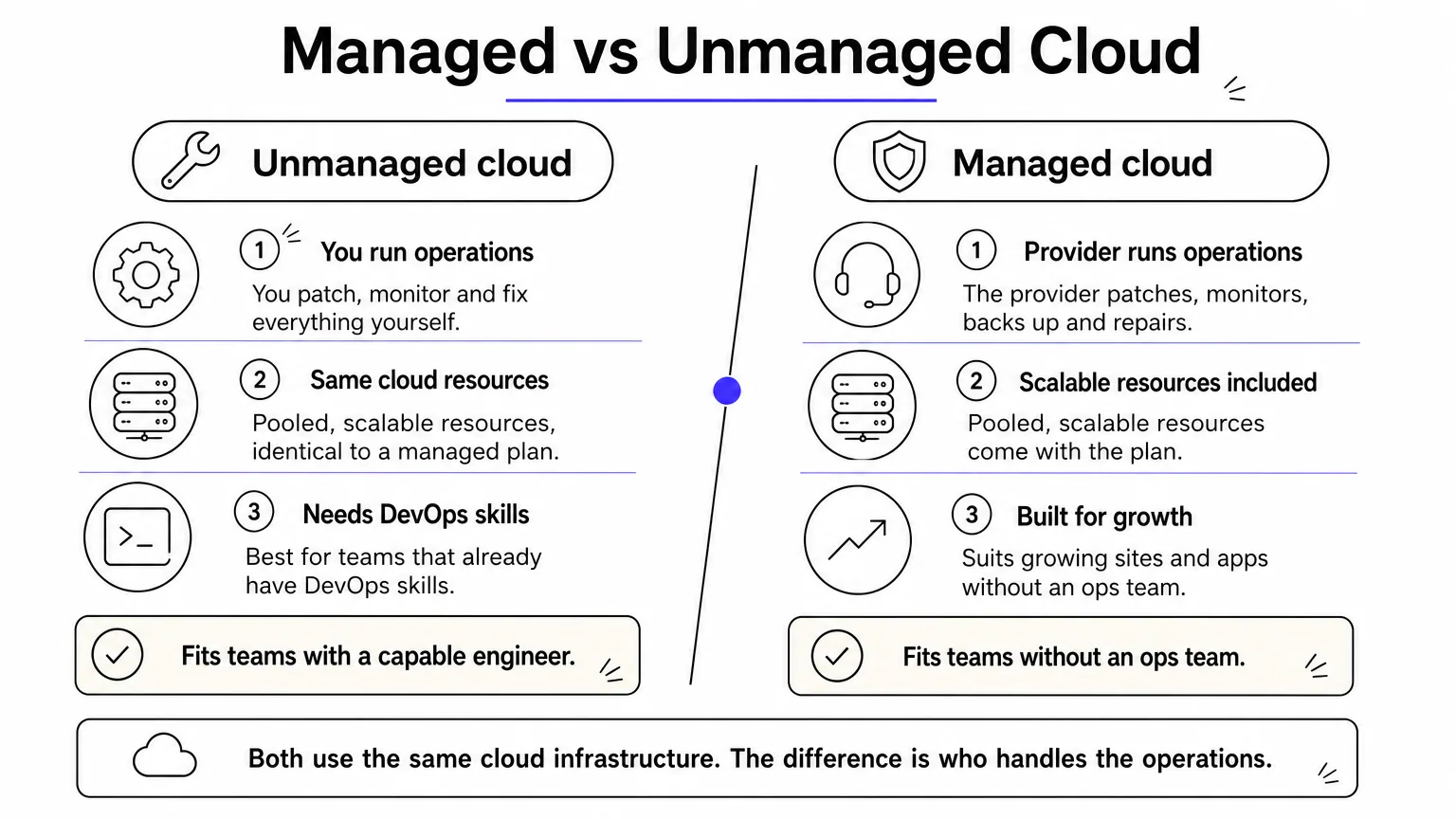
Hosted cloud is a different axis. It usually describes who owns the infrastructure, often a provider-run environment you use largely as configured. Managed describes who operates it. The two can overlap, but a hosted environment with little customization is not the same as a managed one built around your application.
Cloud decides where your workload runs, and managed decides who looks after it.
What managed cloud hosting costs and where it falls short
Managed cloud hosting costs more on the invoice than raw cloud servers, but often less than the staff time it replaces. Exact prices depend on the provider and your workload, so compare the pricing model first and the number second.
How providers price it
Most providers use one of three models: fixed monthly plans, usage-based billing, or reserved capacity at a discount for committing in advance. Usage billing suits unpredictable growth. Reserved capacity only saves money if you actually use what you reserved. Always ask about data transfer, backups and extra environments, which show up as separate line items.
Here is a worked example with assumed numbers. Say an engineer worth $80 an hour spends 8 hours a month on patching, backup checks and monitoring. That is $640 a month in time, before any night-time incident. If the managed premium for the same server is below $640, you come out ahead. Be wary of "free" managed hosting. Trials and entry tiers exist, but a person watching your server is paid work.
Trade-offs to weigh
You give up some control. Providers restrict certain configurations, and unusual requirements may not fit. You also accept some dependency on their tooling and support quality, which is why the ownership questions above matter.
Steady, predictable workloads can be cheaper on unmanaged servers if you already employ a capable engineer. If that is you, managed hosting adds cost without much benefit.
Managed hosting pays off when your engineers' time is worth more than the premium.
Where to go from here
Managed cloud hosting gives you scalable cloud resources plus a team that patches, monitors, backs up and repairs them. Compare providers on what they manage, how fast a human responds, how pricing works and whether you keep ownership of your setup. Skip it only when your site is simple or you already have strong in-house operations.
If you want a second opinion on your hosting setup, or need cloud infrastructure built and run for you, book a free 30-minute call with Arrowbin. A senior engineer will tell you what fits your product and what it should cost.